 Select Languange
 English
 Spanish
 Polish
 Japanese
 Italy
SIPS Eco Panels: EPS Insulation Recycling with the GREENMAX MC200
EPS is widely used in the construction industry because of its excellent thermal insulation properties. During the manufacture of insulated building components, materials need to be cut to specific dimensions, inevitably generating large volumes of EPS offcuts. Managing this production waste efficiently is an important part of day-to-day operations for building materials manufacturers.
Based in Glenrothes, Scotland, SIPS Eco Panels is a building materials manufacturer that uses EPS as insulation in its products. The offcuts generated during production come from a known source, making them easier to separate and collect directly at the manufacturing facility.
Before introducing on-site densification, SIPS had to send its EPS waste away for incineration. Due to its low density and bulky nature, large volumes of loose EPS quickly occupied valuable factory and storage space. The company also had to cover ongoing transportation and incineration costs, creating a considerable financial burden.
As waste management costs continued to increase, SIPS began evaluating alternative solutions. After comparing different options, the company purchased a GREENMAX MC200 hot-melt densifier in 2016 and started processing EPS offcuts directly at its facility. The previous approach, which relied mainly on off-site incineration, was replaced by a process involving on-site collection, hot-melt densification, consolidated transportation and further recycling.
How the GREENMAX MC200 Improves EPS Storage and Transportation
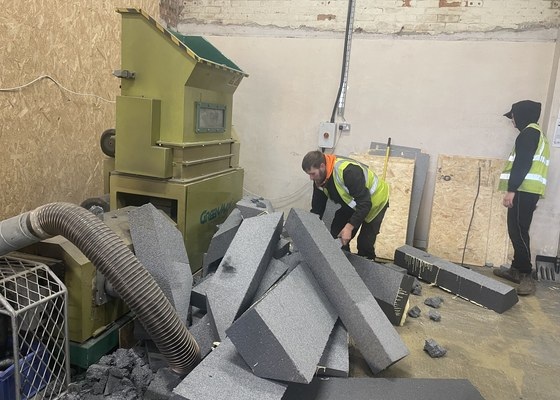
For SIPS, the main challenge was not complex material sorting but the large volume occupied by loose EPS and the resulting transportation and disposal costs. Installing a hot-melt densifier at the production facility allowed the company to process offcuts on-site, reduce waste accumulation and improve transportation efficiency.
The GREENMAX MC200 is an EPS hot-melt densifier that combines crushing, heating and screw extrusion to convert loose EPS into denser PS ingots.
In the SIPS project, the MC200 achieves an approximate volume reduction ratio of 90:1. After hot-melt processing, a single truck can carry around 20 tonnes of densified material. Actual results may vary depending on feedstock characteristics, material dimensions and operating conditions.
This significantly improved SIPS's waste handling process. Instead of transporting large volumes of bulky EPS offcuts for incineration, the company could first densify the material at its facility and then arrange consolidated shipments. This reduced storage requirements and made subsequent transportation more efficient.
Further Recycling of MC200 Hot-Melted EPS
The recycling process at SIPS does not end when the material leaves the MC200. According to the project information, the PS ingots produced by the machine are sold and transported to mainland Europe, where downstream recyclers process them into recycled plastic pellets. These pellets are then supplied to XPS manufacturing plants.
For SIPS, the MC200 solved the problem of managing bulky production offcuts, while the processed PS ingots provided a material that could be sold through an established downstream channel. Instead of paying for transportation and incineration, the company can now sell the densified material as feedstock for further recycling, turning a disposal cost into a potential source of revenue.
From EPS densification to downstream pelletising, GREENMAX provides equipment for different stages of the recycling process. In addition to EPS hot-melt densifiers such as the MC200, the company also supplies plastic pelletising equipment and integrated recycling lines. Systems can be configured according to material type, processing capacity and target pellet specifications, covering densification, pre-treatment and extrusion pelletising.
For businesses planning in-house recycling, front-end densification can be combined with downstream pelletising to establish a complete processing line suited to their production requirements.
INTCO Recycling also offers potential purchasing cooperation for qualifying EPS compacted blocks and hot-melted ingots. Purchasing arrangements are assessed according to material quality, quantity, location and current demand. Businesses can continue working with existing downstream recyclers or explore recycling cooperation with INTCO Recycling.
By combining equipment supply, integrated pelletizing systems and potential material recovery, GREENMAX and INTCO Recycling can support businesses looking for a more comprehensive approach to EPS recycling.
What the SIPS Project Means for Other EPS Insulation Manufacturers in the UK
SIPS has been using the GREENMAX MC200 since 2016, demonstrating how on-site hot melting can become part of a long-term manufacturing waste management process. The value of this project lies not only in reducing EPS volume but also in changing how production offcuts are collected, processed, transported and recovered.
For other EPS insulation manufacturers in the UK considering a similar approach, the first step is to assess their own waste streams. Weekly EPS waste volumes, offcut dimensions, collection frequency and existing transportation and disposal costs all help determine whether on-site densification is a suitable option. If several production areas generate EPS offcuts, the factory should also consider how to collect and transfer the material efficiently to the processing area without creating additional manual handling costs.
It is equally important to confirm downstream recycling arrangements before purchasing equipment, including the receiving facility, material specifications and practical shipment volumes. The SIPS project demonstrates that combining on-site hot-melt densification with a reliable downstream sales channel can help manufacturers keep production offcuts in the recycling supply chain.
For building materials manufacturers looking for similar solutions, GREENMAX provides Customised Solutions based on EPS waste volume, site conditions and downstream recycling requirements, including individual machines and integrated recycling line configurations for different production scales.
If your business also generates EPS insulation offcuts and wants to reduce storage, transportation and disposal costs, Contact Us to discuss your material, processing capacity and equipment requirements.