 Select Languange
 English
 Spanish
 Polish
 Japanese
 Italy
Italy
How an Appliance Retailer Specified a GREENMAX Polystyrene Densifier to Replace a Failing Legacy Unit
East Coast Appliance needed to replace an unreliable ten-year-old machine while managing enough EPS packaging to fill two 40-yard containers every week. The new specification focused on payload efficiency, labour reduction, indoor exhaust and an identified route for the densified material.
Project snapshot
- Customer: East Coast Appliance
- Case location: Eastern United States
- Sector: Appliance retail, distribution and after-sales services
- Material: Rigid expanded polystyrene appliance packaging
- Current waste scale: Around two 40-yard containers each week
- Selected machine: Custom GREENMAX M-C100 polystyrene densifier
- Order reference: GM-25069
- Project status: Purchased and awaiting delivery in the source case
Important project status: The source describes the procurement stage. The M-C100 had been purchased and was expected to arrive within several weeks. Any storage, haulage or labour benefits are expected outcomes until commissioning data becomes available.
Why appliance retail creates a persistent polystyrene recycling challenge
East Coast Appliance combines retail sales with delivery, installation, appliance removal and repair. The company operates two warehouses and plans to open a third as the business expands.
Every refrigerator, washing machine, television or dishwasher can arrive with several large pieces of rigid EPS. Unlike cardboard, these mouldings do not fold flat. They build up quickly in goods-in, unpacking and dispatch areas.
The business generated enough packaging to fill roughly two 40-yard containers every week. This is primarily a volume problem: the material is light, but it consumes expensive warehouse and vehicle capacity.
The cost was spread across storage, labour and haulage
Loose EPS required frequent container collections and continued disposal expenditure. It also created hidden operational costs because staff had to move, cut and store material around normal warehouse activity.
- Low-density material produced inefficient vehicle payloads.
- Container changes interrupted normal site routines.
- Bulky foam occupied space needed for stock and order preparation.
- A third warehouse could replicate the same inefficient waste process.
The project therefore needed to improve the economics of polystyrene recycling at source, before the material entered the transport network.
Why replacing the old machine was urgent
The previous melting machine was more than ten years old. Frequent faults and unstable operation meant it was no longer a dependable part of the warehouse process.
Throughput did not match the waste stream
At only around 50–100 pounds per day, the machine could not keep pace with the amount of packaging generated. One employee was required to operate it for much of the day.
Manual preparation reduced productivity
The crusher could not accept many large, hard EPS sections. Staff had to cut them into smaller pieces, transferring work from the machine back to the warehouse team.
The indoor environment needed attention
Without an effective extraction system, fumes and odours were noticeable during melting. The replacement project therefore included exhaust as a core specification rather than an optional afterthought.
A procurement process built around operational evidence
The decision team reviewed technical specifications, throughput, price, finance, delivery, custom configuration, after-sales support and the proposed purchase of recycled EPS.
It also contacted appliance companies already using GREENMAX systems. For a distribution business, references from similar warehouses can be as important as catalogue data because they show how equipment performs with real packaging sizes and labour routines.
Why the GREENMAX M-C100 specification was different
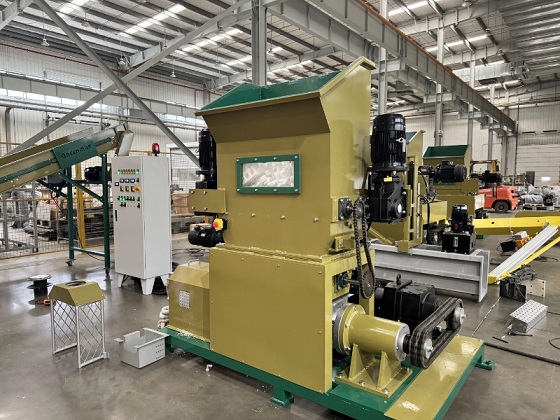
Double crushing for large mouldings
The selected design uses double crushing to process larger rigid sections with less manual cutting. This should shorten preparation time and reduce the risk of the machine becoming a labour-intensive bottleneck.
More heating capacity
The heating system was increased to support stable densification and consistent ingot production across hard appliance packaging.
Exhaust for an indoor warehouse setting
The machine includes an exhaust configuration to improve fume and odour management. The final installation must still be integrated with site ventilation, risk assessments and applicable workplace requirements.
Finance and the downstream outlet shaped the final decision
The customer used a finance arrangement to reduce the pressure of the initial investment. This allowed the business to address an immediate operational problem while planning for future warehouse growth.
The proposed material-purchase service was equally important. Densification has limited value if the output has no buyer. In the planned model, the ingots return to a recycling system and are converted into recycled polystyrene for new products.
Retail and delivery operations → EPS packaging segregation → on-site densification → consolidated ingot collections → reprocessing → recycled plastic products
Expected outcomes once the system is commissioned
The M-C100 is intended to restore reliable on-site processing and remove the mismatch between the warehouse waste stream and the old machine’s capacity.
- Fewer large pieces requiring manual cutting.
- Less loose EPS held in warehouse staging areas.
- Lower dependence on frequent container collections.
- Improved consistency of densified material.
- A traceable route from packaging waste to a recycling outlet.
What UK appliance retailers and reprocessors can learn from the case
In the UK, packaging EPR guidance applies across producers, reprocessors, exporters, compliance schemes and material facilities. This increases the importance of knowing what packaging is generated, how it is prepared and where it is reprocessed.
For appliance retailers, a polystyrene densifier can improve payload efficiency, but equipment alone is not a complete strategy. The site also needs clean segregation, sufficient throughput, a suitable exhaust design, maintenance support and a confirmed downstream reprocessor.
A UK feasibility review should compare current skip or container costs, staff handling time, weekly EPS volume, available floor area, power and extraction requirements, and the quality specification required by the material buyer.
FAQ
Why is expanded polystyrene difficult for appliance warehouses to manage?
EPS appliance mouldings are large and rigid but very light. They consume storage and container capacity quickly, creating poor payload efficiency and repeated handling.
What capacity did the old machine provide?
The source case states that the previous machine processed only around 50 to 100 pounds of EPS per day and required near-continuous attention from one employee.
Why was an exhaust system included in the new polystyrene densifier?
The legacy machine released noticeable fumes and odours inside the warehouse. Exhaust was therefore included to improve the suitability of the new process for indoor operation.
Are the project benefits confirmed after installation?
No. At the time documented, the M-C100 had been purchased and was awaiting delivery. The expected reductions in loose storage, collections and labour still need to be verified after commissioning.
Why does a material buyer matter in polystyrene recycling?
Densifying EPS only solves the volume problem. A confirmed buyer or reprocessor is needed to turn the ingots into recycled raw material and complete the recycling route.
Assess a polystyrene densifier for your UK appliance operation
Provide GREENMAX with photographs of the EPS, weekly container volumes, the dimensions of the largest mouldings, warehouse space and current collection costs. The resulting assessment can compare machine capacity, labour implications, extraction requirements and the proposed recycling outlet.