 Select Languange
 English
 Spanish
 Polish
 Japanese
 Italy
Bracken Foam Fabricators: Nearly Nine Years of EPE Recycling with the GREENMAX Z-C100
Based in Cork, Ireland, Bracken Foam Fabricators processes a range of foam materials and provides customised foam products for its customers. Cutting and converting EPE (expanded polyethylene) inevitably generates production offcuts. Although the material remains recyclable, loose EPE is soft, bulky and prone to springing back after compression. Left untreated, it takes up valuable production and storage space, while transporting it in loose form makes poor use of available vehicle capacity.
For Bracken, the challenge was to manage PE foam offcuts continuously and prepare the material for further recycling. At the time, the company was also handling a significant amount of higher-density foam. According to company owner Adrian Bracken, the ability to deal with different foam densities was one of the considerations when selecting the equipment.
Connecting Foam Processing with an Existing Recycling Route
Bracken's choice of equipment was also linked to its relationship with upstream supplier Sealed Air. Bracken processes foam material supplied by Sealed Air, while the compacted PE foam blocks can be returned to Sealed Air for further recycling.
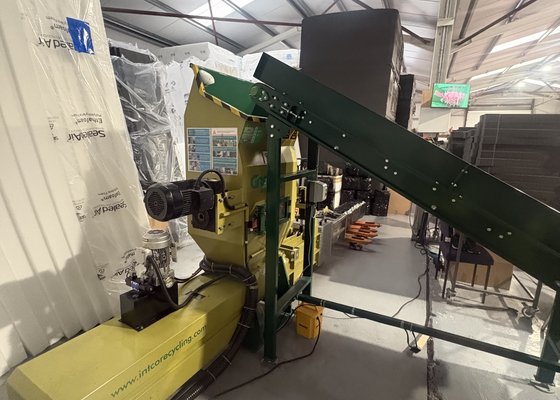
In 2017, Bracken selected the GREENMAX Z-C100 to handle its PE foam waste. With EPE being flexible, bulky and highly resilient, the machine reduces the volume of loose foam and helps form more stable compacted blocks, making the material easier to store, handle and transport.
How the GREENMAX Z-C100 Processes Bracken's EPE Offcuts
The GREENMAX Z-C100 reduces the volume of PE foam through size reduction, screw compression and surface heating. EPE offcuts are first broken down into smaller pieces before being mechanically compressed by the screw. Surface heating is then applied during the forming stage to help the compacted material maintain a more stable shape.
Rather than fully melting the EPE, the process combines mechanical compression with surface treatment to limit the tendency of the material to spring back. The resulting PE foam blocks are denser and easier to store and transport as part of Bracken's polyethylene recycling process.
The Z-C100 has become part of Bracken's everyday production routine. Adrian confirmed that the machine is used every day, allowing EPE offcuts generated during production to be compacted on site instead of accumulating as loose foam around the factory.
EPS Foam Compactor Video:
Around 700 kg of Compacted PE Foam Per Week
Bracken currently produces around 700 kg of compacted PE foam blocks each week.
Once compacted, the material is sold back to Sealed Air for further recycling. Foam supplied to Bracken is converted into finished products, the resulting EPE offcuts are compacted on site with the Z-C100, and the compacted blocks are then returned to Sealed Air.
This gives Bracken an established route for its production offcuts while reducing the problems associated with storing and transporting loose EPE.
How Has the Z-C100 Performed After Nearly Nine Years?
Bracken has been using the Z-C100 since 2017. At the time of the customer interview, the machine had been in service for nearly nine years.
Adrian explained that routine maintenance includes cleaning and greasing the machine, tightening components as originally instructed by GREENMAX, and checking that bolts remain secure. Over long-term use, heating elements and some wiring also require replacement, so Bracken keeps the necessary spare parts available.
Despite years of daily operation, Adrian's assessment of the machine remains positive. He said that the Z-C100 has done what Bracken originally wanted it to do and that the company is very satisfied with its overall performance.
Long-term use has also shown how foam density affects processing. Lower-density PE foam can be handled as part of Bracken's normal daily operation, while very high-density foam can slow the machine down considerably. For projects that regularly generate higher-density foam, GREENMAX can assess the material and recommend a heavier-duty configuration better matched to the application.
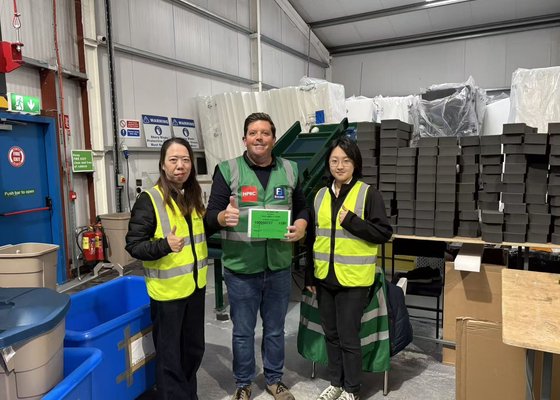
If your business generates EPE, PE foam or other bulky foam waste, GREENMAX can assess your material type, foam density, waste volume, available site space and downstream recycling route to recommend a suitable foam compaction solution.