
 Select Languange
 English
 Spanish
 Polish
 Japanese
 Italy
Italy
How a GREENMAX Foam Compactor Helped Turn EPP and EPS Foam Waste into Higher-Value Recycled Material
Project Snapshot
|
Case location |
Czech Republic |
|
Sector |
Waste management and industrial recycling |
|
Materials |
EPS and EPP foam |
|
Equipment |
|
|
Monthly volume |
Approx. 20 tonnes |
The challenge: EPS and EPP waste were taking up value before creating value
For recycling companies, foam waste can become commercially difficult when logistics costs rise faster than material value. EPS and EPP foam are both widely used in packaging, but they behave differently in recycling operations.
In this case, the customer had to process around 20 tonnes of industrial foam waste per month: half from EPS packaging used in the home appliance sector, and half from EPP packaging used for automotive parts. The EPP material was denser and tougher, with a typical density of 40-70 kg/m3.
For UK waste operators, this is a familiar issue: if bulky foam is moved before it is densified, it can absorb storage and transport capacity while delivering weak payload efficiency.
Why EPP required a stronger configuration
EPP is not just another foam. It is tougher, more elastic and more compact than EPS. This is why the customer needed equipment that could maintain crushing capacity, block stability and continuous operation when switching between materials.
Traditional treatment methods such as landfill and incineration were costly and increasingly unsuitable for a circular resource model. The customer wanted to turn loose, low-value foam into sellable recycled resources.
The solution: GREENMAX Z-C200 foam compactor
GREENMAX recommended the Z-C200 foam compactor after reviewing material characteristics, European downstream market demand and long-term operating costs. Compared with hot-melted material, cold-compacted EPS and EPP foam blocks can circulate more effectively in the European recycled material market and are easier for downstream businesses to sort, transport and reprocess.
This made the Z-C200 a strong fit for a recycling company needing stable, continuous processing of industrial foam waste.
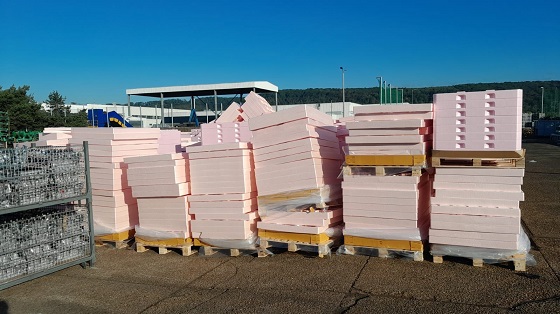
Equipment optimisation for mixed EPS and EPP streams
· Two reinforced 5.5 kW motors in the crushing unit.
· Stronger handling of EPP foam at 40-70 kg/m3.
· Variable frequency speed control on the main screw.
· Stable feeding for lightweight EPS.
· Improved compactness and continuity when processing rigid EPP.
Results: improved payload, storage and recycling value
After installation and remote commissioning, the company could steadily process approximately 20 tonnes of EPS and EPP foam waste per month. Loose industrial foam was crushed and screw-compacted into uniform blocks, reducing storage and logistics pressure while improving recycling value.
For a UK recycler, the commercial lesson is clear: densification is not only about saving space. It is also about improving the quality, consistency and transportability of material before it enters the downstream recycling chain.
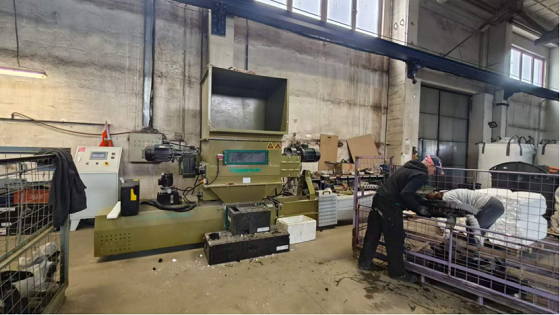
Why this case is useful for UK recyclers
· Better vehicle payload efficiency.
· Lower storage pressure.
· More consistent material preparation.
· Stronger downstream recycling value.
· A more commercially sustainable EPS and EPP recycling model.
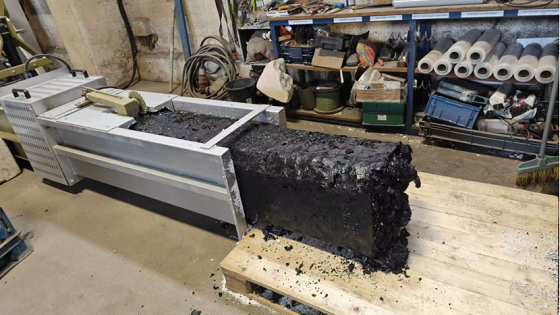
FAQ
Why is EPP foam recycling more difficult than EPS foam recycling?
EPP is denser, tougher and more elastic than EPS, so it requires stronger crushing power and more controlled compaction.
Can the GREENMAX Z-C200 process both EPS and EPP?
Yes. In this case, the Z-C200 was optimised with reinforced motors and variable frequency speed control to process both materials.
Why are cold-compacted foam blocks useful?
They can be easier for downstream companies to sort, transport and reprocess than hot-melted material, especially in markets that prefer cold-compacted foam blocks.
How much foam waste did the customer process?
The customer was able to process approximately 20 tonnes of EPS and EPP foam waste per month after installation.