
 Select Languange
 English
 Spanish
 Polish
 Japanese
 Italy
Italy
Improving EPS Recycling Cost Control with a GREENMAX H-C300 Hydraulic Compactor
Project Snapshot
|
Field |
Details |
|
Case location |
Shanghai, China |
|
Customer |
Shanghai Blue Whale Resources Recycling Technology Co., Ltd. |
|
Equipment |
GREENMAX A-C100 followed by GREENMAX H-C300 |
|
Material |
EPS foam packaging waste |
|
Daily capacity |
Approx. 700-800 kg/day |
|
Compacted density |
Approx. 300 kg/m3 |
|
Machine capacity |
Approx. 200 kg/h |
|
Staffing |
1 operator and 1 maintenance staff |
Why this case matters for the UK market
For UK waste operators, EPS recycling is increasingly linked to cost-per-tonne control, evidence quality and operational reliability. Under packaging EPR, producers and the wider packaging chain face stronger accountability for packaging waste management, while recyclers and reprocessors need material streams that are easier to handle and move.
This case is useful because it demonstrates a practical operating model: a recycler first deployed a smaller foam compactor and later upgraded to a hydraulic compactor as daily EPS volume increased. That upgrade path is directly relevant to UK material facilities, reprocessors and commercial waste contractors.
The challenge: EPS increased handling time and site pressure
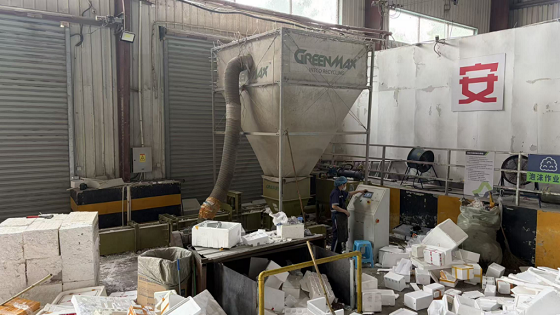
Blue Whale Resources works in recyclable collection, transfer, disposal and waste sorting support. EPS packaging foam from appliances, furniture, cold chain logistics and packaging channels was bulky, low-density and difficult to manage without volume reduction.
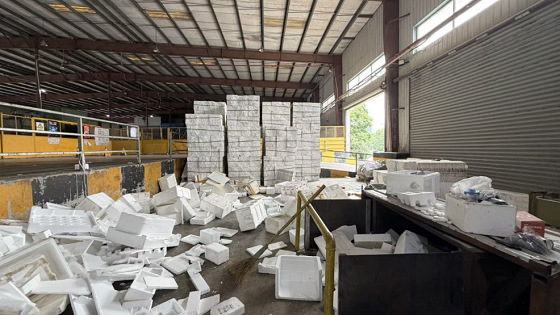
For any reprocessor or transfer facility, untreated EPS can distort operating costs. It occupies bay space, requires more vehicle movements, adds handling time and makes it harder to keep material flow predictable. The key challenge is therefore not only recycling the material, but preparing it efficiently before transport and downstream processing.
Why the customer upgraded to H-C300
The customer first worked with GREENMAX in 2019 and purchased an A-C100 foam compactor. This supported daily EPS handling and improved transport efficiency. As collection volume grew, the site needed stronger compression performance and greater throughput.
In 2022, the customer selected GREENMAX again and purchased the H-C300 foam hydraulic compactor. For UK operators, this demonstrates a common pattern: start with a right-sized solution, then scale the equipment as volume and service commitments increase.
The solution: hydraulic cold pressing for predictable block output
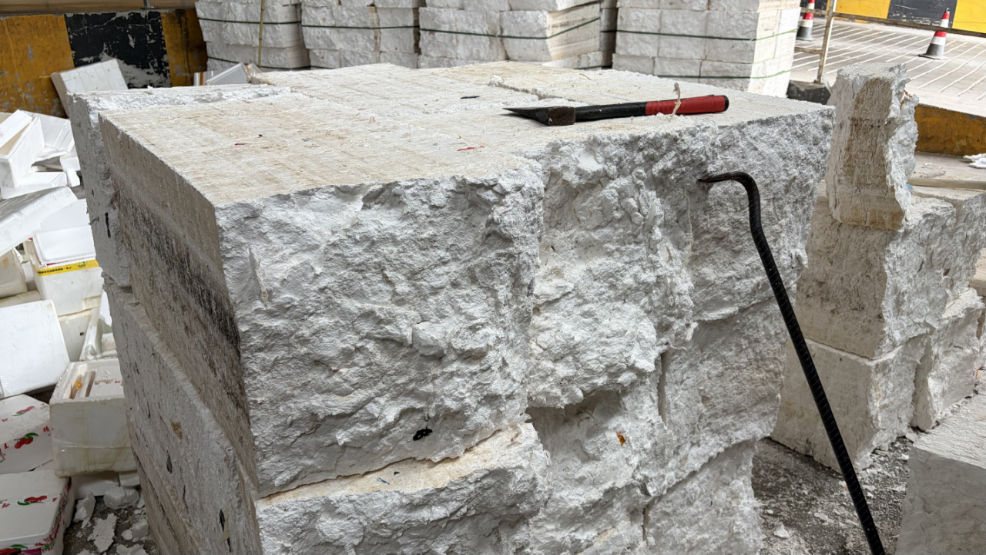
The H-C300 cold-presses loose EPS foam into regular dense blocks. At the site, it processes approximately 700-800 kg of EPS per day, with a compacted density of around 300 kg/m3 and capacity of about 200 kg/h.
This output format matters commercially. Dense EPS blocks are easier to stack, load, transfer and route into further recycling. For UK reprocessors, this helps reduce manual handling pressure and improves the consistency of incoming material streams.
Cost-control benefits for UK recyclers
Lower cost per tonne through improved load efficiency.
Reduced storage congestion at transfer or processing sites.
Less manual handling compared with loose foam management.
Predictable block output for downstream recycling workflows.
A scalable upgrade route from entry-level compaction to hydraulic compaction.
Operational reliability and service response
During operation, abnormal limit signals appeared on site. GREENMAX after-sales support checked the machine, identified a damaged PLC input point for the front cylinder limit and corrected shifted mechanical limit positions after replacement.
The service team adjusted PLC external wiring, optimized the internal program and recalibrated the mechanical limit positions. After maintenance, the machine returned to normal operation. This matters for UK recyclers because uptime, service response and parameter stability directly affect cost-per-tonne performance.
UK market takeaway
The lesson for the UK is clear: EPS recycling performance depends on workflow design as much as machine capacity. If low-density foam is not compacted early, it absorbs labour, transport and site space before it creates value.
A GREENMAX H-C300 hydraulic compactor can support commercial recyclers, local-authority-linked contractors, material recovery facilities and reprocessors by turning EPS from a bulky handling issue into a denser, easier-to-control recycling stream.
FAQ
What is an EPS hydraulic compactor?
An EPS hydraulic compactor uses cold pressing to compress loose EPS foam into dense blocks for more efficient storage, handling, collection and recycling.
Why does EPS increase cost per tonne?
EPS has very low density, so it occupies storage and vehicle space quickly. Without compaction, labour and transport costs can rise faster than recovered material value.
What daily processing volume was achieved in this case?
The customer processed approximately 700-800 kg of EPS foam per day.
What compacted density did the H-C300 produce?
The compacted density was around 300 kg/m3.
Why is service support important for EPS recycling equipment?
Daily recycling operations depend on uptime. In this case, GREENMAX adjusted PLC wiring, optimized the program and recalibrated mechanical limits to restore normal operation.