
 Select Languange
 English
 Spanish
 Polish
 Japanese
 Italy
Italy
How GREENMAX Z-C200 Helped a Packaging Company Improve Foam Recycling Throughput
Project Snapshot
|
Case location |
Germany |
|
Sector |
Foam packaging and industrial waste recycling |
|
Materials |
EPE, EPP, EPS and other foam packaging waste |
|
Equipment |
GREENMAX Z-C200 foam recycling machine |
|
Monthly volume |
Approx. 30 tonnes |
|
Main angle for UK |
Labour cost, EPR context, reprocessor workflow and parameter support |
The challenge: mixed foam packaging waste from multiple sectors
Stephan Schaumstoffe GmbH is a foam packaging company based in Germany. It mainly serves the German market, while also covering some customers in Austria and Italy. Its end customers include medical, electronics and solar energy businesses, all of which can generate foam packaging waste during production, storage and distribution.
The company processes EPE, EPP, EPS and other foam packaging waste. For high-volume customers, it can provide free waste treatment to secure stable material supply. For smaller waste producers, centralised recycling is often more practical than investing in their own foam recycling machine.
Why UK operators should pay attention
For UK packaging waste processors, material facilities and reprocessors, labour, throughput and consistency are becoming increasingly important. Packaging EPR puts more attention on recycling evidence, recycling obligations and waste disposal costs, so practical capacity matters as much as policy ambition.
A foam recycling machine that can process mixed EPE, EPP and EPS packaging waste helps operators turn bulky low-density streams into a more controlled recycling workflow.
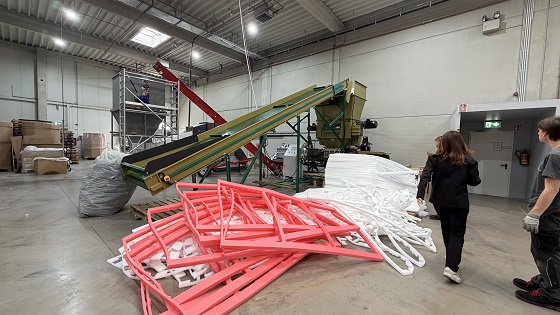
The solution: GREENMAX Z-C200 foam recycling machine
To improve processing efficiency, the customer introduced the GREENMAX Z-C200 foam recycling machine. After commissioning, the company was able to process around 30 tonnes of foam waste per month, making the machine a core part of its daily recycling service.
The Z-C200 was especially useful because the customer did not handle one single material. Different customers supplied foam with different densities, hardness levels, softness and temperatures.
Labour reduction and workflow stability
According to customer feedback, the Z-C200 operates stably overall and performs especially well in reducing labour cost. In the past, the production line might need two shifts with four workers in total. Now, only one worker is required to operate the entire line.
For a UK recycler, this is a practical point: the value of a foam recycling machine is not only measured by compaction. It is also measured by how many people are needed to run the process reliably every day.
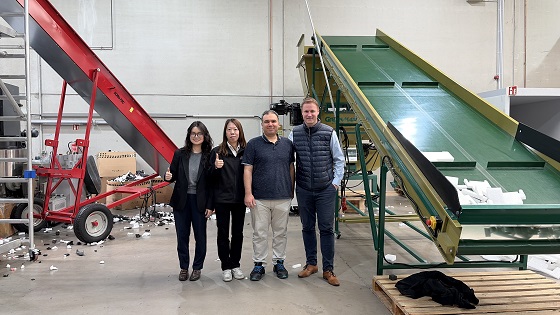
After-sales support: feeding guidance and parameter optimisation
During the customer visit on 8 May 2026, the main discussion focused on feeding methods and parameter settings. If too much foam is fed into the machine at once, blockage, excessive pressure or abnormal noise may occur.
GREENMAX recommended feeding 1-2 pieces at a time and adjusting feeding speed and parameters according to material characteristics. With 8-10 hours of daily operation, this approach can generally meet the customer’s production needs while improving stability.
Why this case is useful for the UK market
UK recyclers handling packaging waste from medical, electronics, solar or manufacturing customers often need flexible equipment because incoming materials are rarely identical. A stable foam recycling machine supports a more predictable service model, lower labour input and better customer retention.
This German case shows that equipment suitability, responsive support and correct operation guidance can be just as important as the machine specification itself.
FAQ
What is a foam recycling machine used for?
A foam recycling machine reduces and processes bulky foam packaging waste so it is easier to handle, store, transport and prepare for downstream recycling.
Which foam types were processed in this case?
The customer processed EPE, EPP, EPS and other foam packaging waste from industries including medical, electronics and solar energy.
How did the GREENMAX Z-C200 reduce labour requirements?
The customer reported that the line previously might require four workers across two shifts. After installing the Z-C200, one worker could operate the whole line.
Why is parameter adjustment important after installation?
Mixed foam materials behave differently. Adjusting feeding speed and machine parameters helps reduce blockages, pressure problems and abnormal noise.