 Select Languange
 English
 Spanish
 Polish
 Japanese
 Italy
CSG Blackburn: Why Choose the GREENMAX PC350?
CSG Blackburn is a specialist hazardous waste and chemical waste management company in the UK. Among the materials handled at its site are containers that may still hold residual liquids, including hand sanitiser packaging. Unlike fully emptied plastic containers, this type of packaging requires the remaining liquid to be separated from the solid packaging before further treatment, making mechanical waste dewatering an important part of the process.
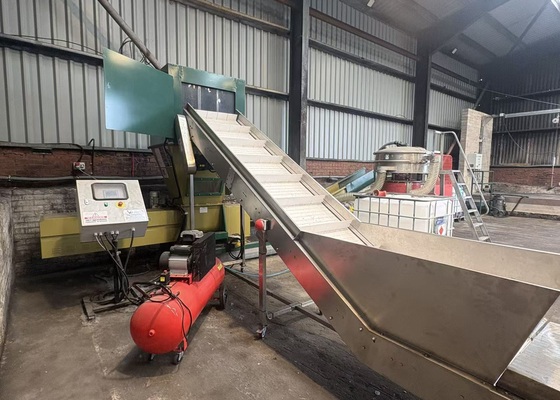
By 2023, increasing volumes meant that CSG's existing dewatering capacity could no longer fully meet demand. The company needed additional equipment to take pressure off the existing operation and increase its capacity for liquid packaging recycling. This was not CSG's first experience with dewatering equipment, but an expansion of an established process. CSG ultimately chose the GREENMAX PC350.
With a RUNI Already in Operation, Why Did CSG Choose the GREENMAX PC350?
Before introducing the GREENMAX PC350, CSG had already been operating a RUNI dewatering machine. The team therefore had first-hand experience of this type of equipment and a clear understanding of what matters in day-to-day operation. When adding further capacity, the decision was not simply about whether a machine could remove residual liquid and compact the packaging. Its practical performance and overall investment also mattered.
After the GREENMAX PC350 was put into operation, CSG gave positive feedback on the machine. According to the project feedback, the team considered its performance comparable with European equipment while offering very good value for money. For a professional waste management company already familiar with dewatering machinery, this provides a useful real-world reference for the GREENMAX PC350 in liquid packaging recycling applications.
UK Installation and Local After-Sales Support
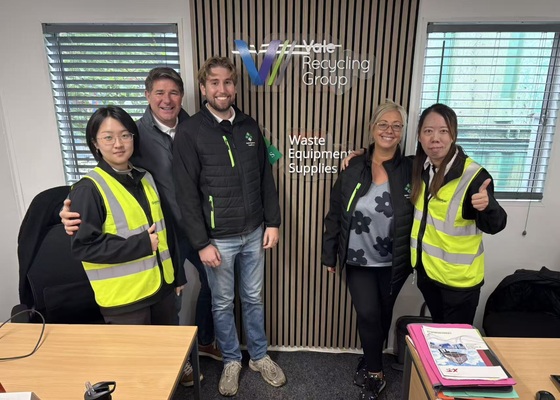
The GREENMAX PC350 at CSG Blackburn was installed by GREENMAX's UK partner, Waste Equipment Supplies, which also provides local after-sales support. For an established waste management site, adding a new dewatering compactor involves more than simply delivering the machine. Available space, feeding arrangements, liquid collection and the route for compacted packaging all need to work with the existing operation.
The local team supported the installation according to CSG's site conditions and remains available for after-sales support. CSG also gave highly positive feedback on the installation and service provided by the GREENMAX UK team. For UK waste operators investing in industrial recycling equipment, having local installation and ongoing support can be an important consideration alongside machine performance.
How Does the GREENMAX PC350 Handle Hand Sanitiser Containers?
Hand sanitiser containers arriving at the CSG site may still contain residual liquid. Before the packaging can move further through the treatment process, the remaining liquid needs to be removed from the solid containers. As volumes increase, emptying each container manually becomes increasingly impractical.
The GREENMAX PC350 dewatering compactor combines mechanical dewatering with compaction. As the containers pass through the machine, residual liquid is squeezed out and directed into the liquid collection area, while the solid packaging is compressed at the same time. This allows the liquid and solid fractions to be separated at the front end and then directed into the customer's existing downstream processes.
The GREENMAX PC350 provides physical dewatering and volume reduction rather than determining how the separated liquid should ultimately be treated. The appropriate downstream route depends on the properties of the liquid, the customer's existing processes and relevant waste management requirements. For a specialist operator such as CSG, the machine acts as a mechanical pre-treatment stage within the wider packaging waste recycling process.
When Should a UK Waste Operator Add More Dewatering Capacity?
CSG's experience highlights a practical issue for waste operators that already have dewatering equipment on site. An existing machine may still be operating normally, but rising waste volumes can eventually exceed the available processing capacity. At that point, the question is not necessarily whether the original machine needs replacing, but whether dewatering has become the bottleneck.
If existing equipment is running for longer periods and liquid-containing packaging is beginning to queue or accumulate, while upstream and downstream processes still have spare capacity, adding another dewatering compactor can directly increase throughput at this stage. If the actual constraint is sorting, feeding, liquid storage or downstream treatment, however, adding another machine alone may not solve the wider processing issue.
Operators considering additional capacity can look at daily packaging volumes, container types, residual liquid levels, machine operating hours and where material begins to accumulate. At CSG Blackburn, the situation in 2023 was clear: the existing dewatering equipment remained in use, but growing demand required additional processing capacity. The GREENMAX PC350 was added to the existing operation to help handle the increased volume of liquid-containing packaging.
For UK companies already using dewatering equipment, the CSG Blackburn project provides a practical example of how capacity can be expanded without necessarily replacing an existing machine. Where dewatering has become the bottleneck, adding further capacity can help the existing liquid packaging recycling process keep pace with growing volumes.