
 Select Languange
 English
 Spanish
 Polish
 Japanese
 Italy
How UK Manufacturers Can Improve Plastic Waste Management with ISO 14001
In UK manufacturing, plastic waste is generated at various stages of production and distribution. Common sources include raw material packaging, protective packaging, production offcuts, rejected products and warehouse packaging. Without a consistent waste management procedure, different materials can become mixed, making on-site storage, handling and subsequent recycling more difficult.
ISO 14001 is an international environmental management standard that helps businesses identify environmental aspects, control their environmental impacts and continually improve environmental performance. For manufacturers, the segregation, storage, transfer and final treatment of plastic waste are all relevant parts of environmental management.
On 10 November 2026, the UK Parliament questioned the government about the cumulative costs and regulatory burden of packaging EPR, highlighting the ongoing environmental management pressures facing manufacturers.
Businesses can respond by establishing clear procedures for waste segregation and storage, recording the quantities and destinations of different waste streams, and selecting suitable equipment to improve on-site waste handling and recycling.
Foam Waste Management
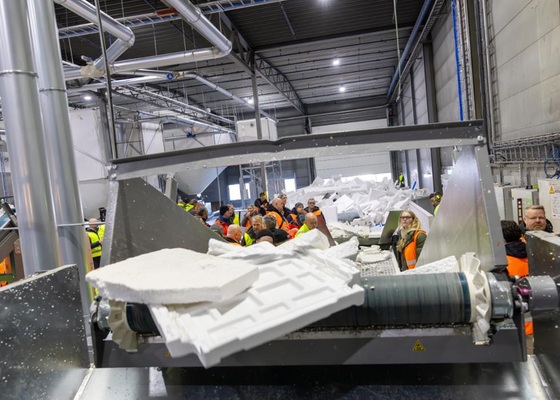
One of the main challenges for manufacturers handling foam waste is its bulky nature. EPS, EPE and EPP are widely used in product protection and industrial packaging. Although lightweight, these materials can occupy considerable warehouse space when stored in their loose form.
Different manufacturing industries generate different types of foam waste:
-
EPS packaging: Appliance inserts, television packaging, electronics protection, furniture packaging and fish boxes.
-
EPE foam: Protective sheets, foam corners, profiles and cushioning materials used for electronics, machinery and precision equipment.
-
EPP foam: Automotive component packaging, reusable transport packaging and protective inserts for industrial parts.
-
XPS insulation: Insulation board offcuts, wall insulation panels and construction material scraps.
-
PSP packaging: Disposable food trays, protective food containers and polystyrene cups.
-
PU foam: Rigid polyurethane insulation board offcuts and industrial insulation foam waste.
-
EPS dust: Fine foam waste generated during EPS moulding, cutting and manufacturing operations.
These materials have different physical properties and should not automatically be mixed or processed using the same equipment. Manufacturers can improve their waste handling arrangements by separating foam at the point of generation and selecting equipment according to material type, daily waste volume and available storage space.
GREENMAX Foam Recycling Solutions
GREENMAX offers several foam recycling machine series designed for different foam materials and processing requirements. The main options include APOLO, MARS, ZEUS and HERACLES (H-C), covering mechanical compaction, hot-melt densification and hydraulic compression.
1.EPS Foam Recycling
EPS is commonly found in packaging for household appliances, electronics, furniture and industrial equipment. Manufacturing and distribution facilities often generate large quantities of EPS inserts, protective mouldings and packaging offcuts.
GREENMAX offers two main solutions for suitable EPS waste.
- APOLO Cold Compactor
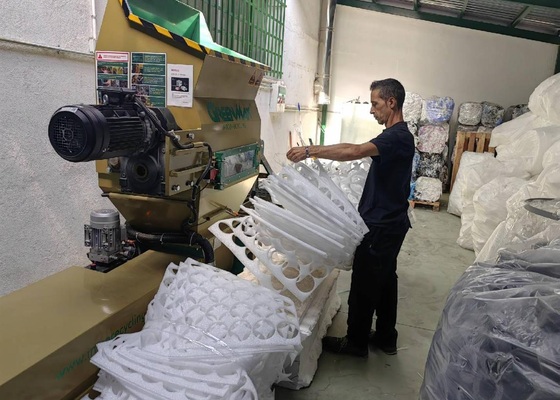
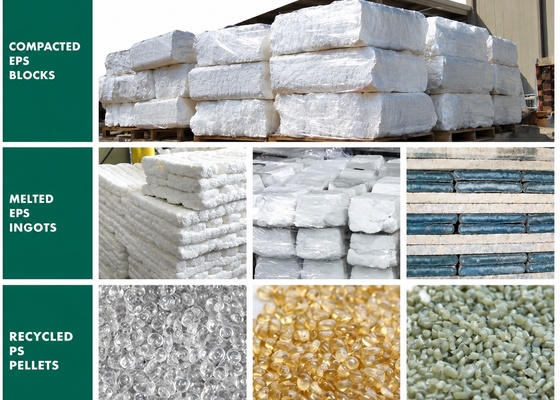
The GREENMAX APOLO Cold Compactor uses mechanical screw compression to turn loose EPS foam into compacted blocks without heating or melting the material. With a volume reduction ratio of up to 50:1, it helps manufacturers reduce storage requirements and improve transport efficiency.
- MARS Hot Melt Densifier
The GREENMAX MARS Hot Melt Densifier combines crushing, controlled heating and screw extrusion to transform suitable foam waste into dense PS ingots. It can achieve a volume reduction ratio of up to 90:1.
For manufacturers generating consistent volumes of EPS packaging waste, hot-melt densification provides a practical way to prepare the material for storage, transportation and further recycling.
Businesses handling other polystyrene materials can also refer to GREENMAX's Polystyrene Recycling solutions.
2.EPE & EPP Foam Recycling
EPE and EPP are widely used in electronics packaging, automotive components and industrial protective packaging.
Unlike EPS, EPE and EPP have greater elasticity and can rebound after conventional compression. Their recycling equipment therefore needs to account for their physical characteristics.
The GREENMAX ZEUS Foam Compactor combines heavy-duty crushing, screw compression and surface melting technology. The process forms a stable outer layer around the compressed material, helping control rebound during storage and transportation.
For electronics manufacturers generating EPE protective packaging and automotive suppliers handling EPP cushioning components, ZEUS provides an option for reducing the volume of suitable foam waste at the point of generation.
For businesses processing polyethylene foam, GREENMAX also provides dedicated Polyethylene Recycling solutions, covering volume reduction and further material recovery.
3.XPS & PSP Recycling
XPS is commonly used in construction insulation boards and building applications, while PSP is found in disposable food trays, protective food packaging and foam cups.
Although both belong to the polystyrene family, their physical forms and waste sources differ.
According to the GREENMAX product range, suitable XPS and PSP materials can be processed using APOLO cold compaction or MARS hot-melt densification.
For construction material manufacturers, this can help manage XPS board offcuts generated during cutting and production. Businesses handling insulation board waste can refer to GREENMAX's XPS Recycling solutions.
Food packaging manufacturers can also assess suitable reduction solutions for clean PSP production waste. More information is available on the PSP Recycling page.
4.PU Foam & EPS Dust Recycling
Manufacturing and construction material processing can also generate rigid PU insulation foam offcuts and EPS dust.
For these applications, GREENMAX offers the HERACLES hydraulic compactor series (H-C), which combines crushing, screw conveying and hydraulic compression to produce dense foam blocks without heating.
The H-C range includes H-C100, H-C200 and H-C300 models, allowing equipment selection according to material characteristics and processing requirements. The product range covers specified materials including EPS, EPS dust, PU insulation foam and suitable EPP materials.
For manufacturers processing rigid PU insulation board offcuts or facilities handling EPS dust, hydraulic compaction can help reduce loose material volume and improve storage and transport conditions.
Mixed post-consumer materials should be separated before processing. PU foam density, structure and condition can also influence machine performance, so material testing is recommended before selecting a model.
Foam Block Buyback & Recycling
GREENMAX's services extend beyond supplying foam recycling equipment. Through INTCO Recycling, eligible compressed foam blocks can also be assessed for buyback and further recycling.
For manufacturers and recycling businesses processing EPS waste, suitable compressed blocks can be collected and evaluated according to material type, cleanliness, quantity and location.
Accepted materials can enter subsequent recycling processes, including crushing, melting and pelletising, to produce recycled PS pellets for further manufacturing applications. This creates an additional recycling route for businesses looking to connect on-site foam densification with downstream material recovery.
Businesses interested in this approach can also refer to GREENMAX's Polystyrene Recycling information, which explains how suitable polystyrene foam materials can be processed for further recycling.
Buyback availability depends on material quality, quantity, output condition and logistics. Other foam materials, including EPE, EPP, XPS and PU, require separate assessments based on their recycling routes.