
 Select Languange
 English
 Spanish
 Polish
 Japanese
 Italy
Italy
EPS Insulation Offcut Compaction: Equipment Choices for UK Manufacturers
UK insulation manufacturer Springvale recycles clean EPS offcuts back into production where capacity allows. White EPS that cannot be accommodated within its manufacturing process is compressed and sent for external recycling, according to its case study published by the BPF Expanded Polystyrene Group.
For UK manufacturers assessing EPS insulation offcut compaction, the starting point is the material that needs to leave the factory. Separating this from offcuts reused in production establishes the workload for the equipment and the quantity available for external polystyrene recycling.
Choosing a suitable compactor involves more than comparing hourly throughput. Board dimensions, feeding arrangements, block handling and the timing of customer returns all affect how the system fits into the factory’s operation.
Compacting EPS Insulation Offcuts Before Collection
Cutting EPS insulation boards produces long strips, large sections and smaller pieces. These irregular shapes leave considerable empty space when collected together. A container can fill quickly without holding much weight, while further offcuts continue to accumulate beside the cutting line.
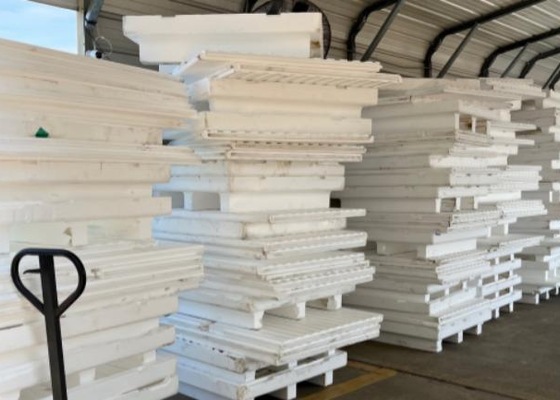
Assess the equipment against the quantity requiring external recycling. Where clean offcuts already return to production, account for them separately from the material intended for compaction. Include any accepted customer returns that follow the same external recycling route.
For this material, cold compaction breaks down the foam and uses screw pressure to form dense blocks. GREENMAX APOLO polystyrene compactors offer a volume reduction ratio of up to 50:1, with the achievable result depending on the material and feeding conditions. The blocks can then be prepared for pallet storage and collection.
The layout needs space for the complete handling process. Positioning the compactor near the offcut collection point can reduce internal movement, while the discharge area should allow blocks to be removed and pallets moved without obstructing production traffic.
Feeding Large Board Offcuts into a Polystyrene Compactor
Rated throughput in kilograms per hour does not show how readily a machine will accept the factory’s board offcuts. Long strips may span the feed opening rather than enter it, while wide sections may need preparation before loading. If operators spend much of the available time reducing pieces to size, that work will limit the overall processing rate.
Offcuts that fit the feed opening and can be supplied consistently may suit direct feeding into an appropriately sized foam compactor. Where large sections repeatedly require manual preparation, a separate shredder may be worth assessing. A material trial should include the long strips and large pieces normally produced by the cutting lines.
A GREENMAX installation at a US EPS manufacturing site combines a front-end crusher, conveyors, a storage silo and a compactor. Oversized scrap is reduced in size and transferred into the silo before being conveyed to the compaction stage.
This type of buffer can help where several cutting lines produce material at different times or customer returns arrive in batches. A factory with smaller quantities and straightforward manual feeding may need a simpler arrangement.
Material transfer between stages also matters. If shredded EPS still has to be bagged, moved and emptied into the compactor, those tasks remain part of the workload. Assess the feeding system as a whole, rather than selecting each machine solely by its individual capacity.
Producing Blocks That Suit Pallet Handling
The discharge arrangement deserves the same attention as the feed opening. During a trial, check whether the compacted blocks remain intact when moved and can be stacked securely on the pallets used by the factory.
Blocks that break apart create additional clearing and handling work. Their length also affects loading: long sections may overhang a pallet or be awkward in a confined area, while short pieces require more individual movements to build a load.
The US manufacturing installation includes an automatic cutter to produce blocks of consistent length. For a similar configuration, the cutting length should suit the factory’s pallet dimensions and loading method, with sufficient space to remove output without repeatedly interrupting processing.
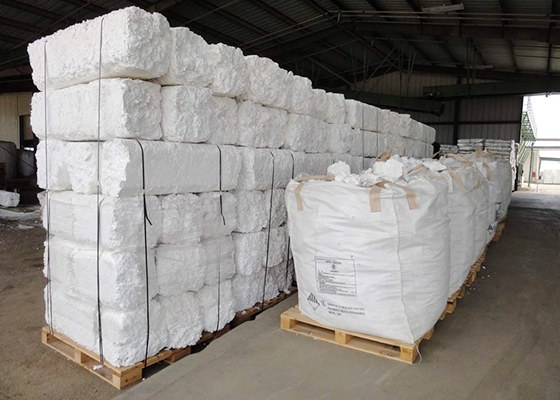
Confirm the recycling partner’s requirements before settling the equipment configuration. Acceptance of cold-compacted blocks does not necessarily mean acceptance of heat-densified material, or vice versa. A representative output sample can help establish whether the proposed form meets the receiving company’s requirements.
French EPS insulation manufacturer Isolfrance provides another example of linking on-site processing with a recycling outlet. Its published case describes sending compressed blocks and densified ingots to INTCO Recycling for further processing. For UK manufacturers planning EPS insulation offcut recycling, the receiving route should similarly be agreed before choosing the equipment and output form.
Allowing for Production Offcuts and Customer Returns
Springvale’s customer take-back scheme accepts clean EPS offcuts for reuse in manufacturing or compression for external recycling. These returns can introduce a different workload from offcuts generated steadily on the factory’s own production lines.
Two factories handling the same weekly weight may therefore need different processing capacities. One may spread the work across several shifts; another may need to clear a returned batch within a single shift while continuing to process new production offcuts.
Available storage affects the decision. Where a site has suitable space to hold a batch and process it over several days, a lower processing rate may be workable. Where loose material quickly occupies loading or production areas, the system needs to clear it within a shorter window.
Record normal and peak quantities alongside the effective processing time available. Include preparation, feeding and block handling, rather than treating the entire shift as uninterrupted machine operation. Trials with representative offcuts can then establish whether the proposed configuration meets the required daily output.
UK insulation manufacturers assessing a foam compactor can provide GREENMAX with photographs and dimensions of typical offcuts, the daily weight requiring external recycling and the time available for processing. Details of customer returns and the recycling partner’s acceptance requirements will help determine whether the site needs direct feeding or additional shredding, conveying, silo storage and automatic cutting.