
 Select Languange
 English
 Spanish
 Polish
 Japanese
 Italy
When Should UK EPS Recyclers Move from Densification to Pelletising?
The UK plastics recycling industry is placing greater emphasis on keeping recovered material in the country for reprocessing. The British Plastics Federation has called for stronger domestic reprocessing capacity, better recycling infrastructure and greater demand for recycled materials. In October 2026, UK recycler Enva announced that it could supply more than 600 tonnes of high-quality white recycled PS compound per month for white goods manufacturing. For EPS recycling in the UK, the next opportunity may lie in retaining more of the downstream reprocessing stage domestically once collection and volume reduction are already established.
EPS Densification Makes Collection and Transport More Practical
EPS is widely used for fish boxes, appliance packaging and industrial protective packaging. Its low bulk density means loose material quickly fills storage areas, skips and vehicles, making transport one of the main practical barriers to commercial polystyrene recycling.
Businesses generating a regular stream of EPS can separate it at source and reduce its volume before collection. A GREENMAX EPS compactor uses physical compression to produce dense blocks, while a foam melter uses heat to produce compact ingots. Both methods significantly reduce the space required for storage and make the material more economical to transport to a specialist reprocessor.
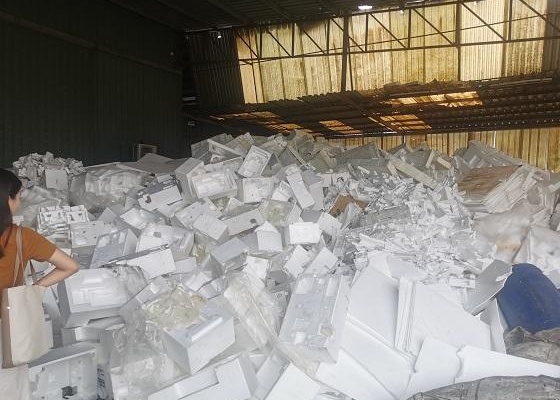
This model fits the way many commercial EPS waste streams are handled in the UK. Recyclers can consolidate material from retail, logistics, manufacturing, seafood packaging and other business sources, while on-site volume reduction makes collection and transport more efficient.
For many warehouses, distribution centres and manufacturing sites, this is as far as the process needs to go. Their priority is to manage bulky EPS efficiently and move it into an established recycling route, rather than process the material into recycled PS themselves.
Some Compacted EPS Still Leaves the UK for Reprocessing
EPS Group industry information shows that compacted EPS collected in the UK is also sent to established mechanical recyclers in European markets including Germany, the Netherlands, Belgium and Spain.
Once compacted EPS blocks or densified ingots reach a reprocessing facility, the material can be prepared for extrusion, melted and filtered before being pelletised. The resulting recycled polystyrene pellets can then return to plastics manufacturing as a secondary raw material.
Volume reduction and pelletising perform different roles within the same recycling chain. An EPS densifier makes low-density foam practical to store and transport, while pelletising takes the material further towards a reusable PS raw material. GREENMAX's existing polystyrene recycling process covers both stages, from reducing the volume of loose EPS to downstream reprocessing.
As the UK looks to retain more recovered plastics for domestic reprocessing, this downstream stage presents an opportunity for recyclers that already have sufficient EPS feedstock.
A Pelletising Line Needs a Consistent EPS Feedstock
Continuous extrusion and pelletising require a reliable flow of material. A single warehouse, fish market or manufacturing site may generate EPS every week but still be better served by on-site compaction followed by bulk collection.
Professional recyclers operate on a different scale. Material can be consolidated from several commercial customers, regional collection points and long-term recycling contracts. Once these sources provide a regular supply of compacted EPS, bringing extrusion and pelletising into the same operation becomes more practical.
Feedstock quality also becomes more important further down the process. Production offcuts and clean industrial packaging tend to provide a more consistent material stream, while commercially collected EPS may contain labels, tape, residues or other non-PS material. Sorting and feedstock control therefore need to match the quality required for the recycled PS produced.
Moving from volume reduction to pelletising is more suitable for recyclers that can control both the quantity and consistency of the EPS entering their facility.
EPS Foam Compactor Video:
The Market for Recycled PS Is Just as Important
Enva's recent recycled PS project provides a useful reference for the wider UK market. The company can supply more than 600 tonnes of white recycled PS compound per month under long-term supply arrangements with white goods manufacturers. Much of its feedstock comes from its own waste electrical and electronic equipment recycling operations, connecting a stable waste source with an identified end market for recycled PS.
Although this project does not use EPS as its feedstock, it highlights two conditions that also matter to EPS reprocessors: a consistent supply of polystyrene waste and a reliable market for the recycled material.
A recycler with established buyers for compacted EPS blocks or ingots may have little reason to change a working model. Pelletising becomes more relevant when the business can maintain sufficient feedstock and has customers able to take recycled PS pellets on a regular basis.
Extending EPS Recycling Beyond Densification
Not every business involved in UK EPS recycling needs to process foam all the way into pellets. Waste producers can use on-site compaction or densification to make collection more efficient, while specialist recyclers can consolidate material from a wider network.
For recyclers already handling larger and more consistent volumes, EPS pelletising offers the option of taking the material beyond volume reduction and producing recycled PS in-house. Whether that investment is justified depends on the existing collection network, feedstock quality and the market available for the finished pellets.
GREENMAX provides equipment for different stages of EPS recycling, including cold compaction, hot melting and downstream pelletising. For UK recyclers with an established supply of EPS, local pelletising makes the most sense when the material can be processed consistently and the resulting recycled PS has a clear route back into manufacturing.