
 Select Languange
 English
 Spanish
 Polish
 Japanese
 Italy
UK Plastic PRN Shortage and the Temporary 83% Measure: What Does It Mean for EPS Recyclers?
The UK plastic Packaging Recovery Note (PRN) market has seen significant volatility in 2026. Tight recycling evidence supply pushed plastic PRN prices higher, and on 9 October the Environment Agency published RPS 383, introducing a temporary regulatory position for the 2026 compliance year in England.
For plastic recyclers, the issue goes beyond PRN prices. Collecting plastic waste is not the same as having that material reprocessed through an accredited route and generating recycling evidence. For businesses involved in EPS recycling in the UK, this raises a practical question: should the business remain focused on collection and volume reduction, or is there a case for moving further into reprocessing?
What Happened to the UK Plastic PRN Market in 2026?
Under RPS 383, where large producers and compliance schemes have obtained evidence covering at least 83% of their legal plastic packaging recycling obligation, and meet the other conditions set out in the position, the Environment Agency will normally not take enforcement action solely because the remaining obligation has not been met.
The 83% figure is not a new plastic packaging recycling target. It is a temporary enforcement threshold relating to the proportion of an organisation's existing legal obligation that has been met. The underlying legal obligation has not changed. RPS 383 is currently due to be withdrawn on 31 January 2027.
Plastic PRNs were already trading at high levels before the measure was introduced. Packaging News reported an average plastic PRN price of £641.15 per tonne for the week ending 11 September, with the average still at £567.97 per tonne for the week ending 9 October. At the same time, the future of the PRN/PERN system remains under discussion. Neither high 2026 PRN prices nor the temporary 83% measure should therefore be treated as fixed long-term conditions.
Why Is Collecting EPS Not the Same as Reprocessing It?
PRNs are generated by accredited UK reprocessors for eligible packaging waste that is reprocessed, while PERNs relate to qualifying packaging waste exported for reprocessing overseas. Collecting, sorting or reducing the volume of plastic waste does not by itself mean that recycling evidence has been generated.
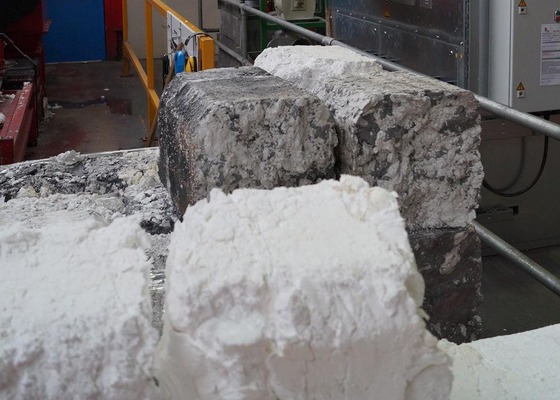
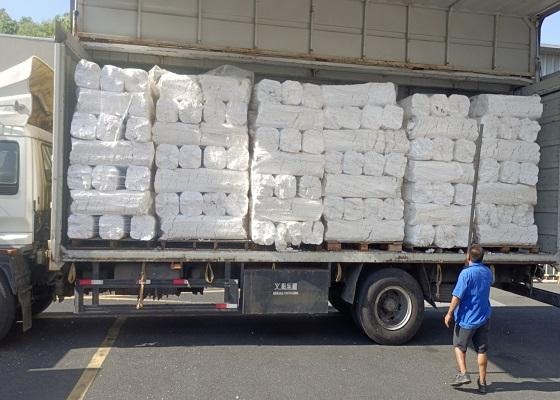
EPS illustrates the distinction particularly well. Loose expanded polystyrene has a very low bulk density and can take up considerable warehouse and vehicle space. Once collected, it therefore often needs to be compacted or densified before economical storage and transport are possible. The resulting compacted blocks or densified material are much easier to handle, but volume reduction primarily solves a storage and logistics problem. The material may still need to go through further stages such as melting, filtration and pelletising.
If EPS is collected and compacted in the UK but the resulting material is then exported for further processing, the front-end recycling operation and final reprocessing take place at different stages of the chain. This is why pressure on PRN evidence supply cannot simply be interpreted as the UK failing to collect enough plastic. Collection capacity and final reprocessing capacity are two different parts of the UK plastic recycling chain.
Should EPS Recyclers Move from Volume Reduction to Pelletising?
Not necessarily. For businesses mainly handling loose EPS, the immediate problem may still be limited storage space, poor vehicle payloads or frequent collections. In this situation, improving EPS volume reduction can be the more practical priority. Increasing the density of EPS makes the material easier to store and transport in larger quantities.
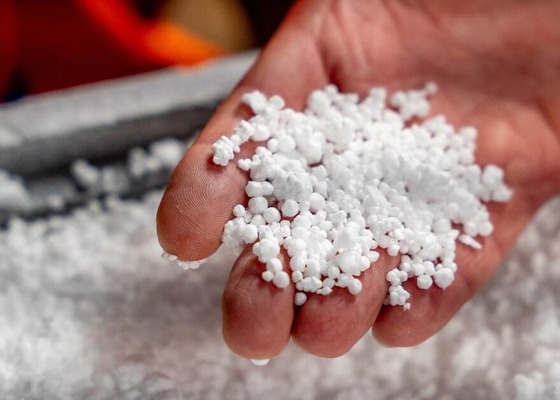
The calculation changes for recyclers that already have access to sizeable and consistent EPS volumes and regularly sell compacted material to other reprocessors or export markets. In these circumstances, it may be worth assessing whether EPS pelletising and further processing into recycled PS pellets fit the existing business model.
Moving into pelletising, however, does not automatically improve returns. It requires suitable feedstock quality and a consistent material supply, while adding energy, labour and operating requirements. There also needs to be a reliable market for the recycled pellets.
What Should Be Checked Before Investing in EPS Recycling Capacity?
Recycling equipment is generally expected to operate for years, while PRN prices and regulatory conditions can change over much shorter periods. For recyclers considering additional EPS recycling capacity, three questions are more important than a short-term movement in PRN prices: Is there enough consistent feedstock? Can the equipment maintain a reasonable utilisation rate? Is there a reliable market for the processed material?
A useful starting point is to review the volume of EPS actually handled over the previous 12 months and determine how much of it is suitable for consistent processing. A business considering a move from volume reduction into pelletising should also assess feedstock quality, energy, labour, maintenance and logistics costs, as well as the market for recycled PS pellets, and compare these with the existing model of selling compacted material.
If storage and transport remain the main constraints, improving front-end volume reduction may still be the priority. Where a recycler already has sufficient EPS volumes, the next question is whether extending into further reprocessing makes commercial sense for the existing operation.
The changes in the UK PRN market in 2026 do not mean that every EPS recycler should add downstream capacity. They provide a reason to look again at where the real bottleneck lies: is it still in collection and volume reduction, or is the business ready to participate further in reprocessing?
If you have questions about EPS recycling, volume reduction or downstream processing, the GREENMAX team can help you assess the options for your operation.