
 Select Languange
 English
 Spanish
 Polish
 Japanese
 Italy
Italy
XPS Recycling in the UK: How Manufacturers Handle XPS Waste
XPS production waste can be recycled when it is kept clean and separated at source. Some UK XPS manufacturers already recover production offcuts and return the polystyrene to manufacturing. For businesses without an in-house recycling system, another practical option is to reduce the volume of XPS at the factory before sending it to an external recycler.
UK XPS Manufacturers Are Already Recycling Production Waste
Ravago Building Solutions has manufactured XPS insulation at its King’s Lynn plant for more than 65 years. The company says it now captures and repurposes 100% of its manufacturing offcuts, including XPS microplastic dust that previously went to landfill.
The recovered dust is compacted into blocks, processed into small pellets and returned to manufacturing. According to Ravago, this prevents around 10 tonnes of waste from going to landfill each year and provides enough recovered material to produce approximately 240 m³ of insulation.
Polyfoam XPS takes a similar approach. Its UK factory has a recycling station integrated into the production process to handle start-up material and offcuts generated when insulation boards are cut. The recovered polystyrene is returned to production, and Polyfoam reports that recycled polystyrene can account for up to 30% of some production runs.
The two manufacturers use different processes, but the principle is similar: keep clean XPS production waste separate and recover the polystyrene before it becomes mixed with other factory waste.
Why Process XPS Waste at the Factory?
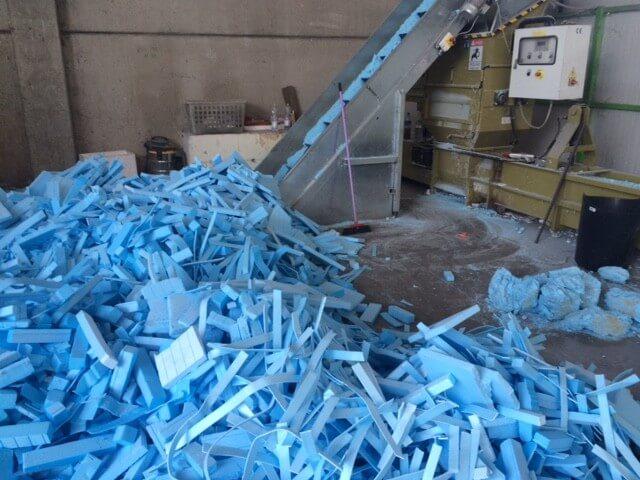
Production offcuts are generally easier to control than mixed post-use waste. XPS coming directly from manufacturing or cutting can be collected before it becomes contaminated with wood, metal, adhesive, film or other materials.
There is also a practical reason to deal with it at source. XPS is lightweight and bulky, so continuously generated offcuts can quickly occupy production or warehouse space. Sending the material away in loose form also means transporting a large volume of low-density foam.
Disposal costs provide another reason to look for recycling routes. From 1 April 2026, the standard Landfill Tax rate in England and Northern Ireland increased to £130.75 per tonne. The UK government states that the tax is intended to encourage waste reduction and alternatives such as recycling and recovery.
Compaction itself does not reduce a weight-based landfill tax. Its value is different: reducing the physical volume of XPS can make the material easier to store and transport while it moves towards recycling.
What Can Other XPS Waste Producers Do?
Large XPS manufacturers may be able to return recycled polystyrene directly to their own production lines. An insulation converter, building-products manufacturer or other business cutting XPS may not need such a complete recycling system.
For these businesses, a more practical route can be to separate clean XPS offcuts, reduce oversized pieces when necessary and compact the material before collection.
This approach is already being used in XPS manufacturing. Iberfibran, an insulation manufacturer in Portugal, introduced a GREENMAX APOLO A-C200 to handle XPS waste generated during production. Instead of sending bulky offcuts away in loose form, the material is compacted at the factory, making it easier to store and prepare for downstream recycling.
GREENMAX XPS compactors use mechanical screw compression rather than melting the foam. Depending on XPS density, shape and feeding conditions, the volume can be reduced by up to approximately 50:1. Large XPS boards may need size reduction before compaction, while smaller offcuts that meet the feeding requirements can be processed directly.
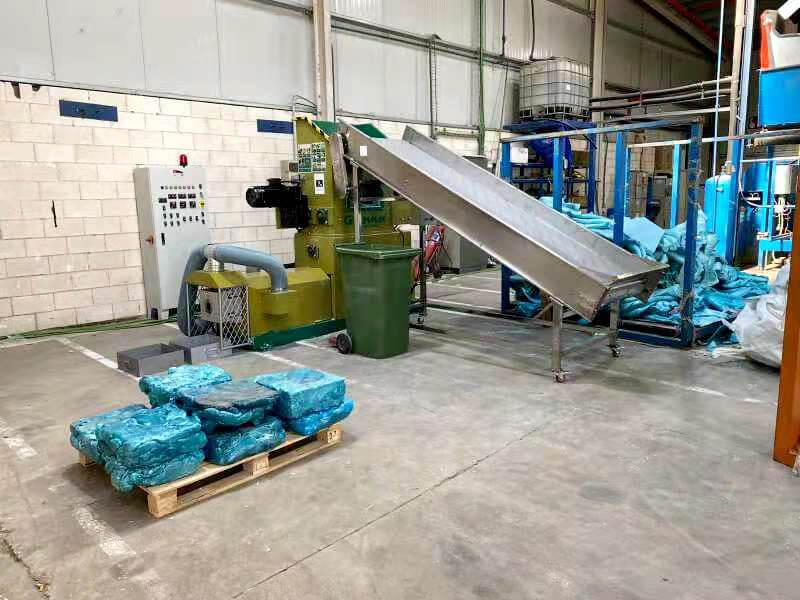
The Iberfibran case also shows an important difference between on-site compaction and a complete closed-loop recycling system. A manufacturer does not necessarily need to pelletise XPS and return it directly to its own production. Where a suitable downstream recycling route exists, compaction can provide a practical intermediate step between factory waste generation and material recycling.
For XPS manufacturers and converters, the first question is whether clean production offcuts can be kept separate and whether a recycler can accept the material. If a recycling route is available but loose XPS is difficult to store and move efficiently, on-site compaction can help bridge the gap between production and downstream recycling.
FAQ | XPS Recycling in the UK
Can XPS insulation offcuts be recycled?
Yes. Clean, properly separated XPS can be recycled where a suitable recycling route is available. UK manufacturers including Ravago and Polyfoam already recover XPS production waste for reuse in manufacturing.
Can recycled XPS be used in new insulation boards?
Yes, under suitable manufacturing conditions. Ravago reprocesses recovered XPS waste for insulation production, while Polyfoam reports that recycled polystyrene can account for up to 30% of some production runs.
When should a business consider an XPS compactor?
On-site compaction is worth considering when a business regularly generates clean XPS offcuts and already has, or is developing, a suitable downstream recycling route. The amount of material, offcut size and density, available space and recycler requirements should all be considered before selecting equipment.
If your business regularly generates XPS offcuts, GREENMAX can assess the material, waste volume and current collection method to determine whether on-site compaction is suitable. Material testing can also be arranged before equipment selection.