
 Select Languange
 English
 Spanish
 Polish
 Japanese
 Italy
Italy
Solar Industry Growth in the UK Is Creating a New Waste Challenge
The UK solar industry is expanding rapidly as the government pushes toward a net-zero electricity system by 2030. Large solar farms and commercial rooftop projects are accelerating across the country, backed by policy incentives and new funding programmes.
Recent clean-energy auctions alone supported over 150 solar projects, helping generate renewable power for millions of households.
At the same time, the UK government continues approving large solar developments, including projects capable of powering hundreds of thousands of homes.
Behind this expansion is a clear policy direction: renewable energy—especially solar—must scale quickly. But as installations grow, so does an often-overlooked issue in the supply chain: solar packaging waste, particularly EPE foam used to protect photovoltaic modules during transportation.
UK Solar Subsidies Driving Industry Expansion
Solar adoption in the UK is supported by several key financial incentives designed to reduce installation costs and encourage businesses to invest in renewable energy.
The most important schemes include:
1. Smart Export Guarantee (SEG)
Under the SEG scheme, energy suppliers must pay solar system owners for surplus electricity exported to the grid. This creates a revenue stream that improves solar project economics.
2. Zero VAT on Solar Equipment
Since 2022, solar panels and related equipment have benefited from 0% VAT, significantly lowering installation costs for households and businesses.
3. Energy Efficiency and Solar Support Programmes
Schemes such as ECO4 and the Warm Homes Plan provide funding for energy-efficiency upgrades, including solar installations in some cases.
4. Business Investment Incentives
UK companies installing solar equipment can also take advantage of capital allowances such as the Annual Investment Allowance, which reduces the tax burden on renewable energy investments.
Together, these policies are pushing solar energy deeper into the commercial and industrial sectors.
However, the rapid increase in installations also means more solar panel packaging waste, much of which is made from expanded polyethylene (EPE) foam.
The Hidden Waste Stream: EPE Foam Packaging in the Solar Supply Chain
Solar panels are fragile and high-value products. During transport from manufacturers to installers, they are typically protected by EPE foam packaging.
EPE foam offers excellent shock absorption and lightweight protection, making it ideal for shipping solar modules. But once panels are unpacked on site, the packaging quickly becomes waste.
For solar distributors, EPC contractors, and installers across the UK, this creates several challenges:
● Bulky foam waste taking up warehouse space
● Increasing waste collection costs
● Limited recycling options for loose foam
● Sustainability expectations from clients and regulators
Because EPE foam is mostly air, transporting it to recyclers without processing is inefficient and expensive. This is why many solar companies are now considering on-site EPE foam recycling solutions.
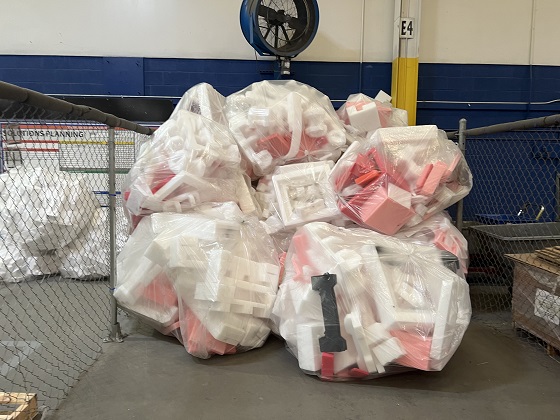
EPE Foam Recycling Machines: Turning Waste Into Reusable Material
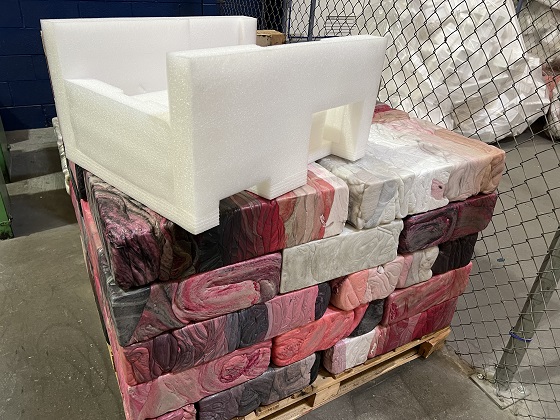
An EPE foam recycling machine compresses or densifies loose foam packaging into compact blocks or ingots that can be reused as raw material.
This approach delivers several operational benefits:
1. Volume Reduction
EPE foam can be reduced by up to 90%, dramatically lowering storage and transport costs.
2. Cleaner Waste Management
Densified material is easier to handle and store compared with loose foam bags.
3. Circular Economy Opportunities
Recycled foam blocks can be reprocessed into plastic products or packaging materials.
For companies involved in solar logistics and installation, this creates a practical path toward closed-loop packaging management.
GREENMAX EPE Foam Recycling Solutions for the Solar Industry
As the solar sector grows across the UK, many companies are looking for reliable recycling equipment that can handle packaging waste efficiently.
GREENMAX, a global brand specializing in foam recycling technology, provides a range of EPE foam recycling machines designed for industrial packaging waste.
These machines are widely used in industries such as electronics, logistics, and renewable energy supply chains.
Key features include:
● High compression ratios for EPE foam packaging
● Continuous operation for industrial environments
● Reduced transport and disposal costs
● Support for corporate sustainability goals
For solar installers, distribution centers, and component manufacturers, integrating an EPE foam recycling machine can significantly improve waste management while aligning with the UK’s broader environmental targets.
Solar Growth and Recycling Must Go Together
The UK’s transition toward renewable energy is accelerating, and the solar industry will play a central role in that transformation.
But sustainability does not end with clean electricity generation. The supply chain—including packaging and logistics—must also evolve.
Recycling EPE foam packaging from solar panels is a practical step that companies can take today.
With the right equipment, solar businesses can reduce waste costs, free up warehouse space, and contribute to a more circular renewable energy industry.
And as solar deployment continues to rise across the UK, EPE foam recycling will become an increasingly important part of sustainable solar operations.
FAQ: EPE Foam Recycling in the UK Solar Industry
What packaging is used for transporting solar panels?
Solar panels are typically protected with EPE foam, EPS foam, cardboard, and pallets during transport.
EPE foam is widely used because it absorbs shocks and prevents damage to photovoltaic modules.
Can EPE foam packaging from solar panels be recycled?
Yes. EPE foam is fully recyclable when it is compressed or densified.
Many companies use EPE foam recycling machines to turn loose packaging into compact recyclable blocks.
Why is EPE foam difficult to recycle without equipment?
Loose EPE foam is mostly air and takes up a large amount of space.
Without densification, transporting it to recycling facilities is inefficient and expensive.
How does an EPE foam recycling machine help solar companies?
An EPE foam recycling machine compresses foam packaging and reduces its volume by up to 90%.
This lowers storage, transport, and disposal costs for solar installers and distributors.
Why are UK solar companies paying more attention to foam recycling?
With the rapid growth of the UK solar industry, packaging waste from panels is increasing.
Recycling EPE foam helps companies reduce waste costs and improve sustainability.