
 Select Languange
 English
 Spanish
 Polish
 Japanese
 Italy
Italy
Large EPS Packaging and Production Offcuts: When Is a Separate Foam Shredder Needed?
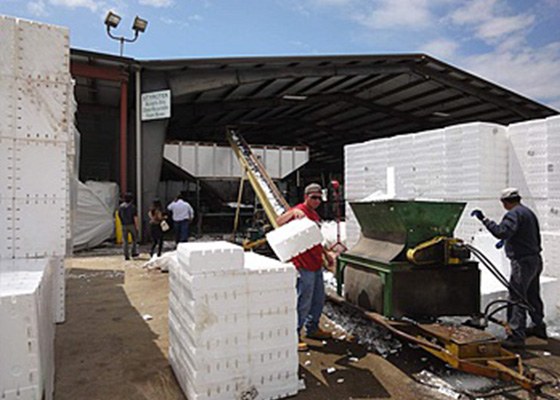
Large EPS packaging and production offcuts can cause feeding problems for recycling equipment, particularly when oversized pieces need to be broken down by hand. This is a common issue for EPS manufacturers, appliance distribution centres and recycling operators across the UK.
Repeated manual preparation can slow down the recycling process. The problem is not always the compactor's processing capacity, but whether the incoming material can be fed into it consistently.
A separate EPS foam shredder may be worth considering when oversized waste regularly interrupts feeding. If an existing compactor can already handle the material without repeated manual preparation, additional shredding equipment may not be necessary.
When Does Large EPS Waste Affect Recycling Efficiency?
EPS waste varies between sites. Packaging manufacturers may produce long cutting offcuts and rejected moulded components, while appliance distribution centres often handle bulky protective packaging from refrigerators, televisions and other appliances.
Even when a compactor has sufficient processing capacity, oversized pieces may exceed the dimensions of its feed opening. Operators then have to break or cut the foam before loading it, leaving the machine waiting for material.
The timing of waste generation also matters. An EPS manufacturer may produce a manageable quantity of waste over a full day, but offcuts can accumulate during particular production periods. If operators regularly stop to prepare oversized pieces, feeding may become the main bottleneck.
Businesses should therefore look beyond the compactor's rated throughput. The time spent preparing material, the frequency of feeding interruptions and the amount of waste accumulating beside the machine are equally relevant.
How Does EPS Pre-Shredding Support Downstream Processing?
Pre-shredding reduces oversized EPS packaging and production offcuts into smaller pieces that can be transferred more easily to downstream equipment.
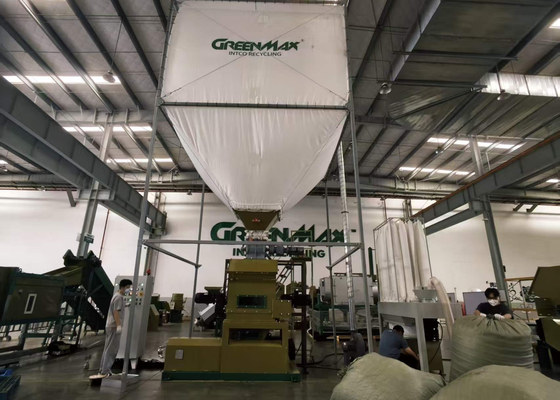
In some recycling systems, large foam pieces pass through an EPS foam shredder before being conveyed to a compactor or thermal densifier. Where waste is generated in batches, a storage silo can temporarily hold the shredded EPS, allowing the two processing stages to operate at different rates.
The required output size depends on the equipment that follows. Excessive shredding can generate additional fine particles and dust, while pieces that remain too large may still cause feeding problems. The aim is to produce material suitable for reliable conveying and subsequent processing.
Where waste generation is relatively steady, shredded EPS may be transferred directly into the compactor. A storage silo becomes more useful when the shredding and compaction stages need to operate at different rates.
Shredding prepares the EPS for further processing but does not reduce it to dense recycled blocks. That requires a subsequent compaction or densification stage.
How a GREENMAX EPS Manufacturer Handles Production Offcuts
A GREENMAX project for an EPS manufacturer in the United States shows how shredding and compaction can be connected within a recycling system.
The manufacturer needed to process production offcuts and rejected foam products. Its recycling arrangement incorporated a separate shredder, conveyors, a storage silo and a compactor.
After shredding, the EPS was conveyed into the silo before being transferred to the compactor. The material was then compressed into dense blocks and cut into manageable lengths by an automatic cutting system.
By holding shredded EPS temporarily, the silo allowed production waste to be processed without requiring the compactor to accept every batch immediately. This provided a steadier supply of material to the compactor, even when production waste was generated in batches.
For UK EPS packaging and insulation manufacturers, the case highlights the importance of matching equipment to the way waste is generated. A separate shredder and silo may be useful for sites handling irregular offcuts in batches, but simpler arrangements may be sufficient where existing equipment can accept the material directly.
When Is a Separate EPS Foam Shredder Worth Adding?
Many EPS compactors already include an integrated shredding system. The GREENMAX APOLO EPS compactor, for example, combines foam size reduction and mechanical compression within one machine.
If the incoming EPS fits the feed opening and can be processed without repeated manual preparation, adding another shredder may offer little benefit.
A separate pre-shredding stage becomes more relevant when oversized moulded packaging or long production offcuts regularly interrupt feeding. Before investing, businesses should establish how frequently operators need to break up material and whether the compactor spends time waiting for waste.
Changes to the existing loading or conveying arrangement may sometimes improve feeding without requiring another machine.
If manual feeding limits throughput, pre-shredding may help. If the compactor is already operating at its processing limit, adding a shredder alone is unlikely to increase overall output.
Available floor space, dust control, maintenance access and the need for additional conveying equipment should also be considered. A standalone shredder needs to fit into the existing workflow rather than simply adding another processing stage.
The GREENMAX M-C300 demonstrates another arrangement in which foam size reduction, intermediate storage and thermal densification are combined within a recycling system. It illustrates how the stages can be coordinated without necessarily requiring a separate standalone shredder.
EPS Foam Compactor Video:
Choosing an EPS Foam Shredder with GREENMAX
GREENMAX supplies EPS foam shredders and EPS compactors for different recycling requirements, including machines with integrated shredding systems and solutions incorporating separate pre-shredding and conveying equipment.
For UK businesses handling large EPS packaging or production offcuts, equipment selection should consider the size and shape of incoming waste, daily volumes and the capabilities of existing recycling machinery.
For companies upgrading an existing recycling line, GREENMAX can also assess available floor space, conveying requirements and how a separate shredder would connect to the current compactor.
Businesses can provide photographs of typical EPS waste, maximum piece dimensions, daily waste volumes and details of their existing equipment to help determine whether direct feeding, integrated shredding or a separate pre-shredding arrangement would be more suitable.