 Select Languange
 English
 Spanish
 Polish
 Japanese
 Italy
Italy
IFAT Germany 2026: Foam Recycling, Packaging EPR and GREENMAX Solutions for UK Businesses
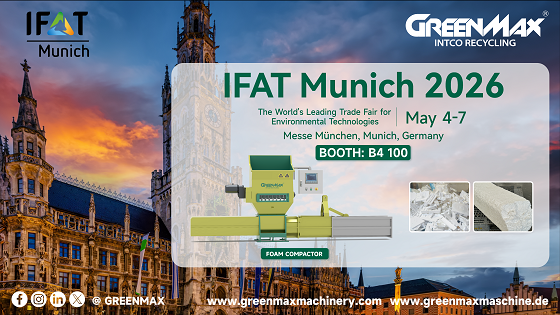
IFAT Munich 2026, held in Germany from 4 to 7 May 2026, is a key global meeting point for environmental technology, recycling equipment and circular economy solutions. For UK companies, the event is especially relevant because packaging waste is no longer only a disposal issue. With packaging Extended Producer Responsibility (EPR), recyclability assessment and disposal fees becoming part of daily compliance, businesses that generate large volumes of foam packaging need a more efficient way to handle EPS, EPE and EPP waste.
At IFAT Germany, GREENMAX highlighted foam recycling machinery that helps companies reduce the volume of loose foam and convert it into dense, transportable material. A strong market signal from the exhibition was that a Brazilian customer placed an on-site order for one MC300E, reflecting international confidence in GREENMAX high-capacity foam recycling solutions.
Industry trends: from waste disposal to measurable circularity
The environmental technology industry is shifting towards practical circularity. Companies want to lower waste costs, reduce carbon impact from unnecessary transport, meet packaging reporting requirements and create cleaner streams for recyclers. IFAT’s 2026 focus on water, recycling and circularity mirrors this shift. Equipment is being judged not only by throughput but by whether it helps businesses produce a consistent output that can re-enter the recycling market.
For foam, this trend is particularly important. Loose EPS or EPE is difficult to move economically because it is mostly air. A lorry collecting loose foam may carry very little plastic by weight. On-site compaction or hot melting changes the economics by turning bulky foam into dense blocks or ingots that are easier to store, load, ship and document.
UK policy background: packaging EPR changes the cost conversation
The UK has introduced packaging EPR guidance covering producers, reprocessors, exporters, compliance schemes, material facilities and other groups. UK organisations affected by EPR may need evidence of packaging waste recycling and may need to pay waste disposal fees. The House of Commons Library explains that packaging EPR requires producers to cover the full cost of managing household packaging waste, including collection, sorting, recycling and disposal after packaging is discarded by consumers.
Although many foam waste streams are commercial or industrial rather than household, the direction is clear: packaging that is hard to collect, bulky to move or difficult to recycle will face increasing scrutiny. UK businesses can reduce risk by separating foam at source and using equipment that prepares it for recycling rather than landfill.
Why foam waste is produced across UK supply chains
Foam packaging is used because it protects goods. EPS protects appliances, white goods, furniture and electronics. EPE cushions fragile parts. EPP is common in automotive, reusable packaging and impact protection applications. Construction and insulation sectors also generate foam offcuts. Once products are unpacked or parts are trimmed, businesses are left with large volumes of lightweight packaging waste.
The challenge is that foam’s strengths during transport become disadvantages after use. Its low density means it occupies bins, cages and warehouse corners quickly. Small beads and fragments can spread around loading bays. If mixed with general waste, foam loses recycling value and may become a pure disposal cost.
Main pain points for UK businesses
UK foam waste generators typically face six pain points: high skip or collection frequency, limited warehouse space, site cleanliness issues, high haulage cost, difficulty proving recycling outcomes and uncertainty around material outlets. These issues affect appliance distributors, fish and seafood processors, fulfilment warehouses, furniture retailers, packaging manufacturers and automotive suppliers.
A practical recycling strategy starts at the point of generation. Staff need to keep foam separate, avoid contamination and feed it into a machine that produces a dense, consistent output. This is where GREENMAX equipment can support both operational efficiency and sustainability goals.
GREENMAX solution: MC300E and foam recycling systems
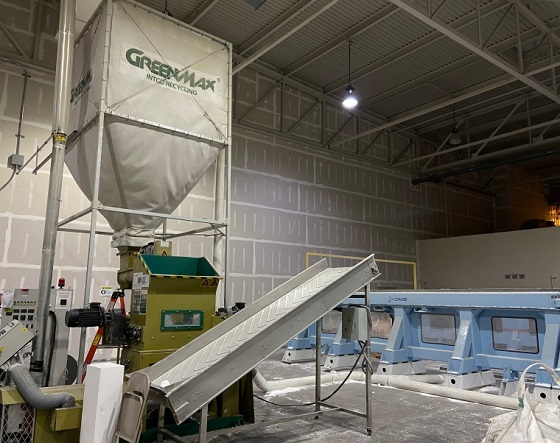
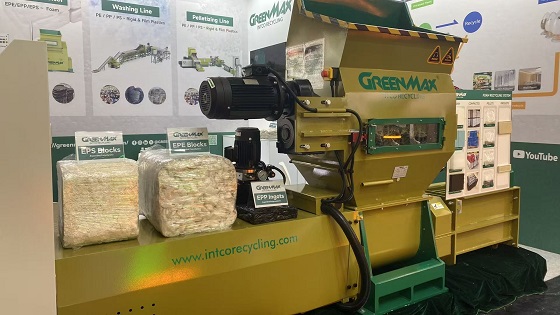
GREENMAX manufactures foam compactors and foam densifiers for EPS, EPE, EPP, XPS and other foam materials. The MARS C300 / MC300E hot melting densifier is designed for higher-volume foam waste. It crushes foam, melts and plasticises it through a screw system, and outputs dense ingots that can be stacked, stored and transported more efficiently. The large crusher and silo configuration helps operators handle bigger foam pieces and maintain more continuous processing.
For UK sites, the benefits include reduced storage pressure, fewer waste movements, cleaner material handling and a stronger route to recycling. GREENMAX can also support equipment selection, project planning and recycling channels, helping customers build a more complete foam recovery process.
Brazilian customer order: a useful IFAT proof point
The Brazilian customer’s on-site MC300E order at IFAT Germany can be used in UK marketing as a confidence signal. It shows that the equipment is being considered by international buyers facing real foam recycling pressures. For UK businesses comparing waste contractors, balers, compactors and densifiers, this type of exhibition order helps show that GREENMAX is active in the global recycling machinery market.
Conclusion
IFAT Germany 2026 shows that recycling technology is moving towards measurable, cost-conscious and compliance-ready systems. For UK businesses generating EPS, EPE or EPP foam waste, the key is to reduce volume at source and create a recyclable material stream. GREENMAX MC300E offers a practical route from bulky waste to dense recyclable output.
FAQ
What is IFAT Germany?
IFAT Germany, also known as IFAT Munich, is a major international trade fair for environmental technologies, recycling, waste management and circular economy solutions.
Why should UK businesses care about foam recycling?
Foam waste can take up large space, increase haulage costs and create compliance challenges. Recycling foam can reduce disposal costs and support packaging sustainability goals.
What does UK packaging EPR mean for businesses?
UK packaging EPR requires affected producers to report packaging data and may require evidence of recycling as well as payment of waste disposal fees.
What materials can GREENMAX foam recycling machines process?
GREENMAX machines can process foam materials such as EPS, EPE, EPP and XPS, depending on the selected model and site requirements.
How does the GREENMAX MC300E work?
MC300E crushes waste foam and uses hot melting densification to produce dense ingots, reducing volume and making the foam easier to store and transport for recycling.