 Select Languange
 English
 Spanish
 Polish
 Japanese
 Italy
Italy
Fully Automatic Baler Machine for PET Bottle Recycling: Efficiency Meets Compression Power
In today’s recycling industry, efficient handling and volume reduction of post-consumer materials like PET bottles are crucial for cost-effective logistics and streamlined operations. A fully automatic baler machine plays an indispensable role in this process, especially for recyclers and material recovery facilities (MRFs) dealing with large volumes of plastic containers.

What is a Fully Automatic Baler?
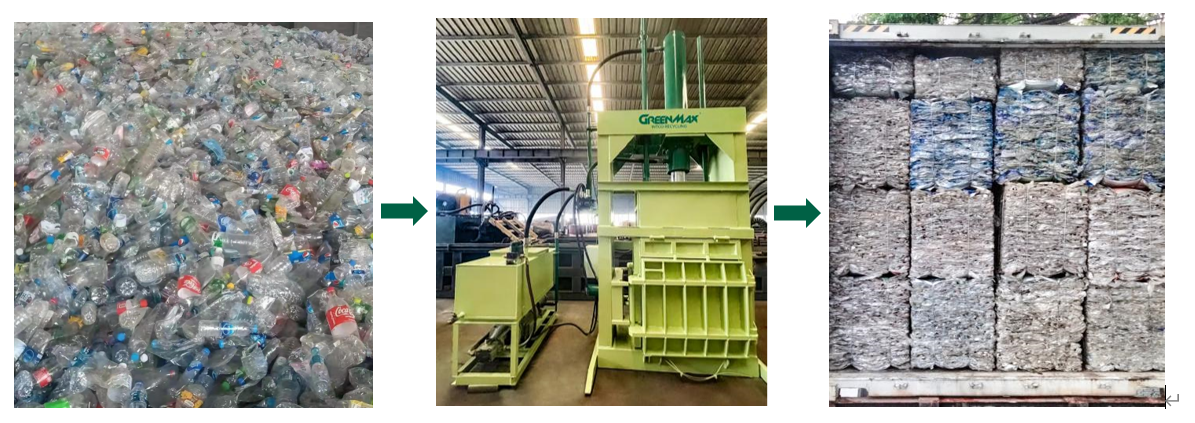
A fully automatic baler machine is a high-efficiency equipment designed to compress recyclables—such as PET bottles, HDPE containers, aluminum cans, and cardboard—into dense, uniform bales without manual intervention. Unlike semi-automatic or manual balers, this machine automates the entire cycle:
Material feeding (usually via conveyor)
Compression with hydraulic force
Automatic tying (wire or plastic strap)
Bale ejection and stacking
This automation not only reduces labor cost but also ensures consistent bale quality, higher throughput, and improved workplace safety.
Why Fully Automatic Balers for PET Bottles?
PET bottles are lightweight and voluminous, making storage and transport challenging. Without compression, even a small quantity can occupy massive warehouse space. Here's how fully automatic balers address this:
1. High Compression Ratio
Advanced hydraulic systems allow these machines to compress PET bottles into dense bales, reducing volume by up to 90%. This drastically lowers transport costs and storage footprint.
2. Contamination Tolerance
Many models are equipped with pre-pressing technology and can handle bottles with residual liquid or light contamination, which is common in post-consumer collections.
3. Fully Automated Tying System
After compression, the bale is tied using steel wire or PET strapping, ensuring the bundle remains stable during handling and shipping.
4. Continuous Operation
These balers are designed for 24/7 industrial usage, making them ideal for high-volume PET recycling operations such as beverage plants, sorting centers, and regional recycling hubs.
Key Features to Look For
Feeding Conveyor System: Automatic feeding allows continuous processing with minimal supervision
PLC Touchscreen Control: Enables easy operation, diagnostics, and monitoring
Adjustable Bale Size: Customizable to fit storage or transportation requirements
Remote Control / Monitoring: For modern facilities requiring real-time machine status and alerts
Safety Sensors & Interlocks: Ensuring operator safety and preventing machine overload
Supporting a Circular Economy
By compacting PET bottles into high-density bales, fully automatic balers contribute to closed-loop recycling. The bales are easier to handle, transport, and feed into washing or pelletizing lines, ultimately transforming waste bottles into new raw materials like rPET flakes or pellets used in textiles, packaging, and even new bottles.
Application Scenarios
Plastic bottle recycling plants
Beverage bottling companies (Coca-Cola, Pepsi bottlers)
Municipal sorting stations (MRFs)
Supermarkets & retail logistics hubs
Export packaging for PET scrap buyers
Conclusion
A fully automatic PET bottle baler is not just a machine—it’s a productivity solution. For any business dealing with large-scale PET bottle recovery, investing in one can lead to lower costs, higher throughput, and a cleaner environment.
Want to explore the right model for your operation? Contact us for a tailored baler solution that meets your volume, bale size, and automation needs.