
 Select Languange
 English
 Spanish
 Polish
 Japanese
 Italy
Italy
Christmas EPE Packaging Waste in the UK: Why It Spikes—and How to Recycle It
From Black Friday deliveries to Boxing Day returns, UK retailers and warehouses deal with a predictable December headache: protective packaging waste. Cardboard stacks up fast, but EPE foam packaging (expanded polyethylene) is often the real space-killer—lightweight, messy, and usually “too awkward” to store until someone can deal with it.
The good news: EPE is recyclable. The challenge is making recycling practical during the busiest weeks of the year.

The UK Christmas packaging spike, in numbers
The festive period creates a genuine, measurable surge in waste. The UK government’s Environment (Defra) blog notes that additional waste from Christmas is estimated to exceed 3 million tonnes.
Packaging is a major contributor. Wildlife and Countryside Link published UK Christmas waste estimates showing that, over the festive period, around 104,946 tonnes of plastic packaging are likely to be burned, landfilled, or exported overseas, and approximately 277,400 tonnes of cardboard are likely to be used.
Zooming out beyond Christmas, official UK waste statistics also underline the scale of packaging overall: Defra’s UK statistics show plastic packaging waste arising in 2024 at ~2.265 million tonnes, with about 51% recycled under one methodology (and similar results under another), and note that packaging Extended Producer Responsibility (pEPR) came into force on 1 January 2025.
In other words: more packaging is hitting sites at peak season, and expectations around responsible handling keep rising.
Why EPE foam becomes a problem for retailers and warehouses
EPE is great at protecting goods—but frustrating at end of life:
It’s mostly air. A small weight takes up a huge volume, filling cages and skips quickly.
It’s easy to contaminate. Tape, labels, and mixed materials reduce recycling value.
It’s costly to “store and wait.” Space in December is worth more than ever.
It’s often treated as “general waste” by default. Not because teams don’t care—because the process isn’t set up for speed.
So the real issue isn’t whether EPE can be recycled. It’s whether your site can do it without slowing down operations.
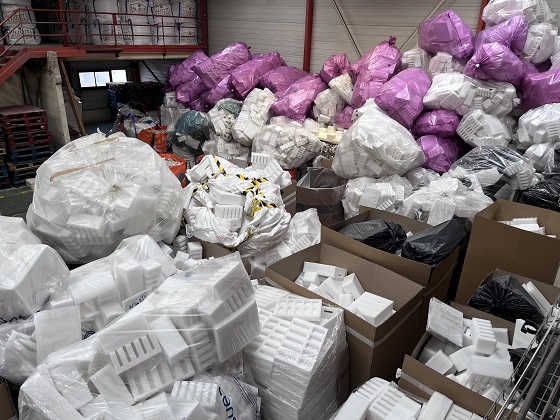
UK recycling options for EPE foam packaging
A workable EPE recycling plan usually combines four moves:
Separate clean EPE at the source
Put EPE in a dedicated cage/bag area (not “mixed plastics”). Removing tape and cardboard makes a big difference.
Reduce volume on-site
If you don’t densify EPE, you’ll pay to transport air. Compacting/densifying turns loose foam into manageable blocks.
Move material to a specialist recycler or end market
Densified EPE is far simpler to store, ship, and sell onward for reprocessing.
Track it (even lightly)
A basic log—bags/blocks per week—helps you prove improvement and plan collections.
A simple “Christmas playbook” for busy sites
If you want something your team can actually follow in peak season, keep it tight:
Step 1: One labeled EPE-only collection point near unpacking/returns
Step 2: Daily “de-tape” routine (2–5 minutes per cage)
Step 3: Densify at set times (e.g., end-of-shift)
Step 4: Stack/store blocks neatly (safe, dry, out of traffic lanes)
Step 5: Arrange regular uplift or backhaul to recycler
That’s it. The key is volume reduction—because that’s what turns EPE recycling from “nice idea” into “normal routine”.
Where GREENMAX fits: EPE recycling machines for warehouses
GREENMAX offers equipment designed to make EPE recycling realistic on-site—especially when foam volumes surge:
Foam compactor (cold compaction with surface stabilisation): Ideal for retailers, 3PLs, and warehouses that need fast, low-fuss volume reduction for EPE/PE foam.
Foam densifier / hot-melt systems: For operations that want higher density outputs and easier transport/storage; some configurations are cited with up to ~90:1 volume reduction for foam densifiers.
The practical outcome is the same: less space lost to foam, fewer collections, and a cleaner route into recycling.
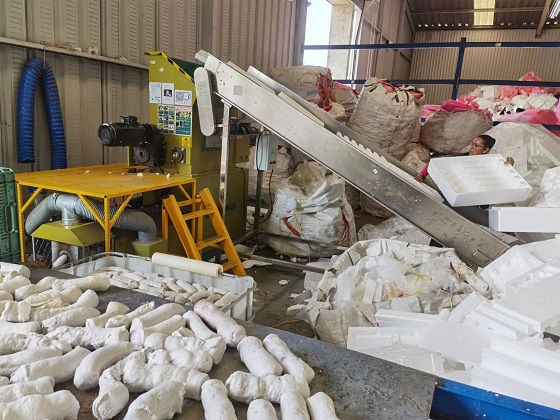
Customer snapshot: a UK logistics site handling PE/EPE foam
One GREENMAX-reported scenario focuses on a British logistics company dealing with recyclable PE foam packaging (commonly including EPE in protective packaging streams). The recommended setup was a GREENMAX PE foam compactor ZC200 with an automatic cut-off setting, plus surface hot-melt technology to help prevent compacted material from loosening—aimed at reducing volume and saving labour during handling.
This is the kind of deployment that makes sense during Christmas: the site doesn’t need to “become a recycling plant”—it just needs a reliable way to stop foam from taking over the yard.
Have a happy, greener Christmas (without the foam chaos)
If you’re planning for next peak season, start small: separate EPE, densify it, and line up a recycling outlet. Once the process is in place, the December spike becomes manageable—and you’ll usually see benefits year-round in returns and inbound goods.
Wishing you a happy, safe, and more sustainable holiday season in the UK.