
 Select Languange
 English
 Spanish
 Polish
 Japanese
 Italy
Italy
EPE Foam Recycling for UK Foam Converters & Fabricators
If you run a foam converting or fabrication operation in the UK, EPE (polyethylene foam) waste is part of daily production: edge trim, skeleton waste, offcuts, set-up waste, rejected sheets/rolls, and protective packaging scraps. The challenge isn’t just the material—it’s the low density. Loose EPE fills up bins fast, takes valuable floor space, and drives up internal handling time and collection costs.
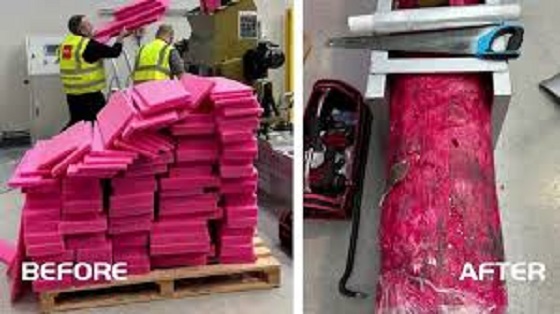
For many UK foam converters & fabricators, the most practical recycling strategy starts with one goal: stop paying to move air. By reducing volume on-site and producing a consistent output, you can simplify storage, improve collection efficiency, and build a more reliable route into recycling.
Why EPE Waste Costs UK Foam Converters More Than It Should
1) EPE is bulky by nature
Even when the weight is low, bins fill quickly. That means more collections, overflow risk, and wasted space around cutting, laminating, and packing areas.
2) Scrap is generated across the workflow
Typical foam converting steps—lamination, CNC cutting, die-cutting, thermoforming, bonding/assembly—produce multiple waste forms (trim, skeletons, mixed-size offcuts) that are awkward to consolidate.
3) Inconsistent scrap makes recycling harder
If EPE is not kept clean and segregated, recycling options narrow and material value drops. The fastest win is to standardise collection at source and convert loose scrap into a consistent, dense output.
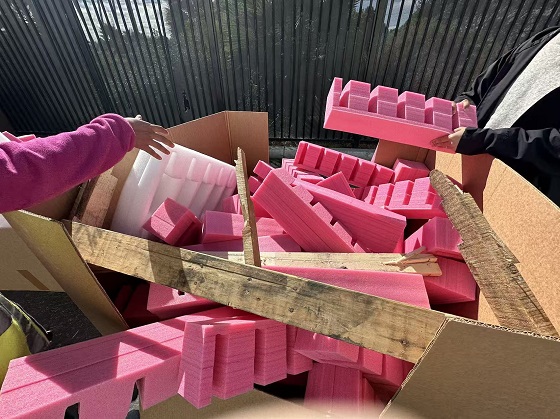
A Practical On-Site EPE Recycling Loop for Foam Converting Sites
A workable workflow for UK foam converters typically looks like this:
1. Capture at the source: place collection bags/bins at cutters, routers, trim stations, and assembly points.
2. Pre-sort and keep it clean: keep EPE separate from heavy adhesive residues, films, labels, and other plastics where possible.
3. Reduce volume on-site: choose mechanical compaction or thermal densification depending on your goals.
4. Create a consistent output: dense blocks/ingots are easier to store, stack, and ship than loose foam.
5. Move into recycling routes: a stable output format makes downstream handling simpler and more economical.
GREENMAX EPE Recycling Machines: Compactor or Hot Melter?
EPE waste in foam converting plants comes in many shapes and sizes, so the right machine depends on your priority: simple mechanical compaction or higher-density thermal output. GREENMAX offers two dedicated EPE recycling routes—both designed for UK foam converters & fabricators.
Option A — GREENMAX EPE Compactor (Cold Compaction)
If your immediate goal is to cut volume and collection frequency with a straightforward, production-friendly workflow, an EPE compactor is often the most direct starting point.
What it does: crushes and cold-compacts loose EPE into dense blocks/ingots.
Why foam converters choose it: simple operation, easy line-side integration, fast payback driven by fewer collections and less storage space.
Best for: steady daily offcuts/trim/skeleton waste, limited floor space, and teams that want a low-complexity on-site solution.
Option B — GREENMAX PE Foam Hot Melter (MARS Series) (Thermal Densification)
If your priority is higher densification and a more solid output form, the hot melter route is designed to deliver that.
What it does: crushing → hot melting → extrusion, turning EPE into dense ingots.
Why foam converters choose it: high densification reduces transport intensity and storage footprint, and the output form can be preferred by some downstream partners.
Best for: higher-volume sites, sites facing extreme space constraints, or operations aiming for a more consolidated, “solid” output.
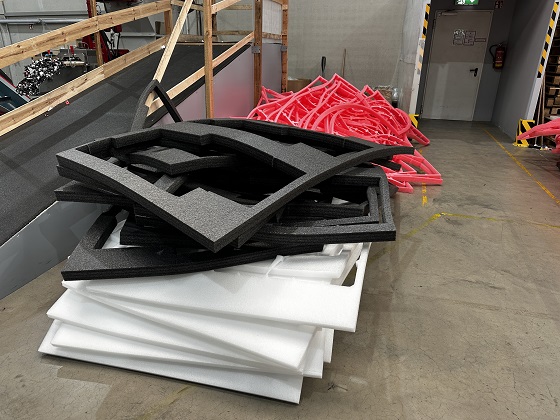
Improve Recycling Results Without Slowing Production
Standardise collection points
Treat EPE scrap like a production by-product: line-side collection prevents “pile and panic”.
Reduce contamination
Keep EPE away from heavy adhesive residues, mixed films, and non-foam plastics.
Batch the right scrap together
Combine similar densities and product types to keep outputs consistent.
Track two simple KPIs
Collections per week (should drop)
Storage area used for EPE waste (should shrink)
FAQ — EPE Foam Recycling for UK Foam Converters & Fabricators
Q1: What EPE scrap types are most suitable for on-site recycling in converting plants?
Edge trim, skeleton waste, clean offcuts, and rejected sheets/rolls—especially when kept dry and segregated.
Q2: Why does volume reduction matter so much for EPE?
Because the major cost driver is bulk: storage footprint, internal handling, and transporting low-density material.
Q3: Can we recycle EPE on-site without disrupting production?
Yes—when collection is line-side and the machine is positioned to match your material flow near cutting/assembly zones.
Q4: How do we size the right EPE recycling machine?
Base it on daily scrap volume, peak days, available space, and whether you prefer cold compaction (Compactor) or thermal densification (Hot Melter).